A chat with science fiction writer Kathy Tyers (a New York Times-bestselling author for her Star Wars novel The Truce at Bakura) about Firebreak, the first book in a new trilogy in her popular Firebird series.
What would you sacrifice to save your family and your home world?
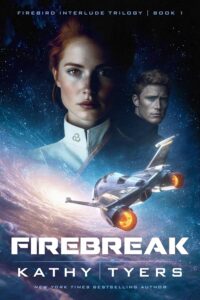
Lady Firebird Caldwell returns to the world of her birth, Netaia, intending to introduce her young sons to the noble Electors while her husband, Brennen, conducts a military inspection. When mysterious ships in distress suddenly approach the planet, the Electorate sends her to initiate first contact. Forced to work alongside a vengeful childhood enemy, Firebird uses everything within her power—even her passion for music—to negotiate, only to discover their alien technology threatens all the worlds she holds dear.
Facing ruthless betrayal, Firebird undertakes a deadly journey to salvage the mission. Brennen must make daring use of his telepathic powers to save human life in the galactic Whorl, including that of their young sons. But saving the worlds might force Brennen to give the order that would mean Firebird’s death. In a galaxy poised on the edge of ruin, survival may demand the ultimate sacrifice—from them both.
About Kathy Tyers
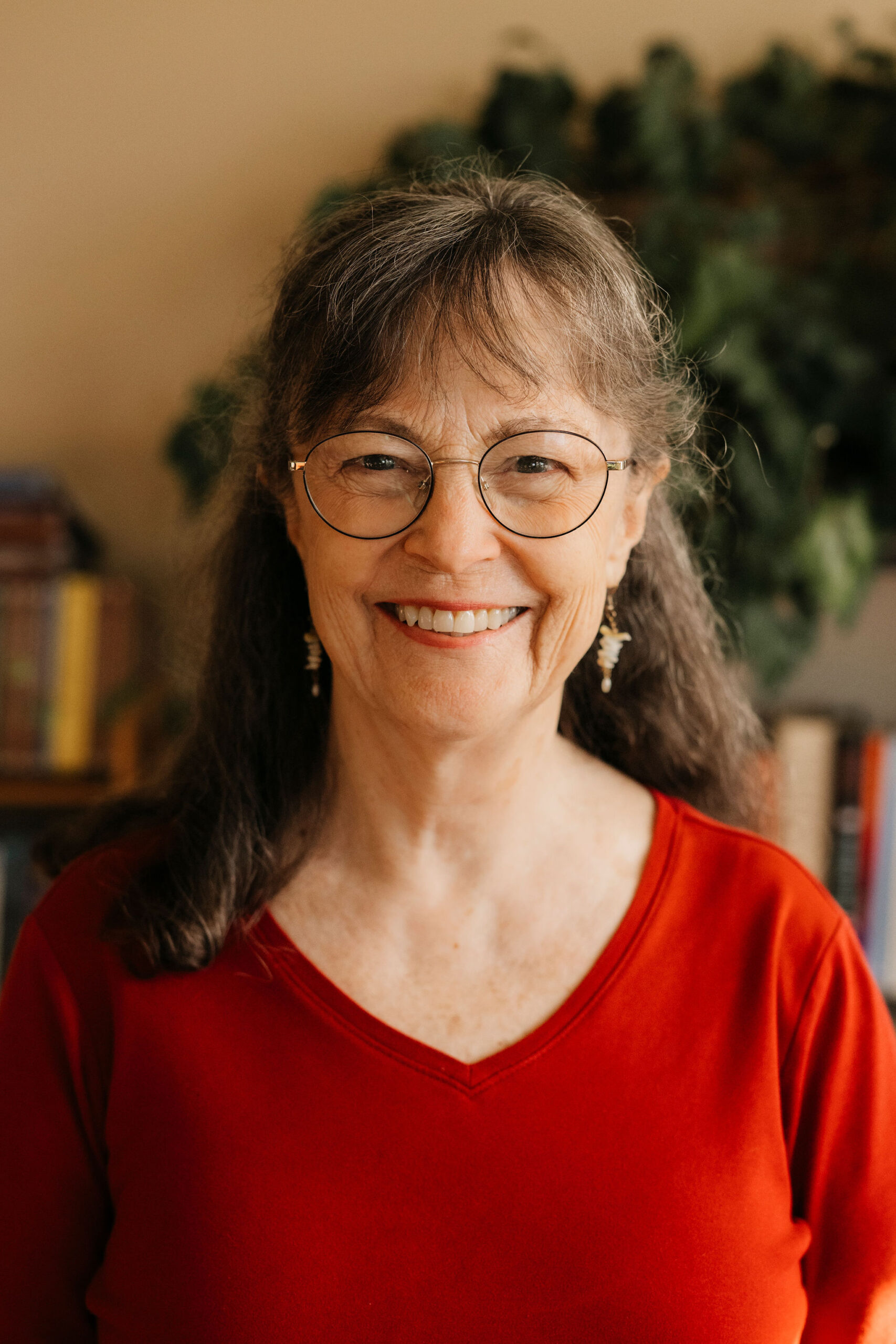
Kathy Tyers
Kathy Tyers is widely known for two Star Wars Legends novels: New York Times-bestseller The Truce at Bakura and New Jedi Order: Balance Point. Her hard science fiction novel Shivering World was long-listed for the Nebula Award and received the Christy Award in the Visionary category.
Kathy’s ongoing Firebird series is adventure-romance space opera reminiscent of Star Wars 4, 5, and 6. Firebreak, the first book in a new Firebird universe trilogy, is a 2026 release. Two additional Firebird Interlude Trilogy novels are scheduled for 2027 and 2028.
At home in southwest Montana with her husband William T. Gillin, Kathy focuses on writing, music, and short-season vegetable gardening.
A chat with bestselling and prolific author John Van Stry about his career and his newest novel, Lock & Load, Book 3 in the Valley of Fire trilogy set in is popular Wolfhounds universe.
In the heart of the Fire Nebula, war rages across the stars.
Crown Prince Wolf Alexander-Morgan and Princess Mariella, forged in the crucible of combat and mech warfare, stand at the forefront of a desperate counterstrike against a ruthless empire that has already struck at their homeworlds. With elite squadrons, aging battleships revived from slumber, and hard-won alliances hanging by a thread, they prepare to carry the fight straight to the enemy’s stronghold.
But victory demands more than firepower. As hidden truths surface, old grudges resurface, and the line between ally and threat blurs, Wolf and Mariella must navigate treacherous politics, overwhelming odds, and the weight of their own destinies. One wrong move could doom their kingdom—or end the war in flames.
Pulse-pounding space battles, brutal ground assaults, and the clash of crowns await in the explosive conclusion to the Valley of Fire trilogy. In a galaxy where loyalty is tested in fire, some legends are born… and others are extinguished.
About John Van Stry
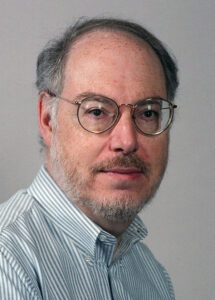
John Van Stry
John Van Stry holds a Bachelor of Science in Electrical Engineering (BSEE). During his college years, he joined the United States Air Force and gained some flying experience. His early career included work in robotics, followed by positions as a Flight Test Engineer in the aerospace industry at Grumman Aerospace, General Dynamics, and Lockheed.
During this time, he acquired a cougar and relocated to Oregon. After leaving aerospace, he transitioned to the medical devices sector as a Quality and Test Engineer in a research and development group, then at Tektronix, before entering contracting, drawn by the financial incentives. By then, he owned several big cats, incurring substantial feed costs that necessitated a dedicated account with a wholesale meat supplier and the purchase of a van for hauling.
He later moved to California, and now resides in Texas. In his roles in quality assurance and testing, Van Stry has been fortunate to engage with cutting-edge technology, witnessing extraordinary innovations and collaborating with brilliant engineers—as well as a few challenging personalities.
Writing has long been a personal pursuit for Van Stry, with contributions to various fanzines and small press outlets. Upon receiving a Kindle as a gift, he entered the world of independent publishing. This proved wildly successful, and in 2015, tired of all the travel associated with contracting, he became a full-time writer.
Violence has an echo, growing louder with each reverberation . . . how do you stop its echo once it starts ringing?
Ashme is a New Mesopotamian—a “Meso.” She dreams of being a hero, fighting against the brutal Ostarrichi ruling her country. She is an indigo child, her DNA modified by sentient AI, enabling her to control computer systems at will. With this power, she has something to offer the Meso resistance. Her twin brother, Shen, however, suffers from a neurological disorder and needs someone to care for him. Increasingly, that task falls on her.
How can she become the hero her people need when her brother’s needs are overwhelming? If she continues caring for Shen while joining the resistance, she risks leading Ostarrichi forces to her home. If she leaves, then looking after Shen will fall to her cousin, who is already overworked caring for his frail grandmother.
As her society collapses into violence, Ashme must choose between her fellow Mesos, her family, and her values.
About Brad C. Anderson
Brad C. Anderson
Brad C. Anderson, author of Duatero and Ashme’s Song, lives with his wife and puppy in Vancouver, Canada. He teaches undergraduate business courses at a local university and researches organizational wisdom in blithe defiance of the fact most people do not think you can put those two words in the same sentence without irony. Previously, he worked in the biotech sector, where he made drugs for a living (legally!).
His stories have appeared in a variety of publications. His short story “Naïve Gods” was longlisted for a 2017 Sunburst Award for Excellence in Canadian Literature of the Fantastic. It was published in the anthology Lazarus Risen, which was itself nominated for an Aurora Award..
A chat with Aurora Award-winning YA author James Bow about his new science fiction novel, The Sun Runners, and its companion anthology, Tales from the Silence.
“Hello, people of Mercury. This is planet Earth. Are you receiving this? Please respond.”
Lieutenant Adelheid Koning was only twenty-three when the Earth’s long fight against its environment ended in collapse and nuclear war. Earth’s sudden silence leaves the colonies of the inner solar system without lifelines, in various stages of self-sufficiency.
Or, in Mercury’s case, not.
To help her fellow stranded colonists of Mercury survive starvation and a breakdown of order, Adelheid fights some cold equations and makes some hard choices, ending up wearing an iron crown as queen of one of the rail cities of Mercury, constantly moving to stay ahead of the Sun.
Fifty years later, Adelheid’s granddaughter, Frieda, is a seventeen-year-old princess who would rather be an engineer. Frieda’s life is shattered when a suspicious accident takes one of her arms—and is then turned upside-down when her mother dies from that accident. Frieda is left a young and vulnerable queen, locking horns with her grandmother, who is now regent and dowager.
When the Earth makes contact again, after fifty years of silence, Frieda is eager to end Mercury’s isolation, but Adelheid is suspicious of the Earth’s sudden return, and wary of the other latitude towns’ desires to accept all that the Earth is offering, without question.
With thousands of lives on the line, is it wise to hope for healing? Or are we forever defined by what we do in the dark?
About Tales from the Silence
On August 4, 2151, the world will end.
It’s been a long time coming: climate disasters brewing conflict, conflict breeding chaos. But on that fateful day, someone will set off the nukes. On August 4, 2151, human civilization on Earth will fall silent.
There are survivors, of course—and not just on Earth. There are scientists on the Jovian moons. Miners in the asteroid belt. Thriving colonies on the surface of Mars and above the clouds of Venus. Far more precarious ones on Mercury. When the silence falls across human space, one thing is clear: Earth’s space-born children are on their own. No more supplies are coming. No more orders. No more meddling. No more help.
Set in the universe of James Bow’s new novel, The Sun Runners, Tales from the Silence is a gathering of award-winning science fiction, fantasy, and YA authors who explore the worlds the Earth left behind, as well as the Earth itself, as they struggle through Earth’s new dark age.
Join James Bow, Phoebe Barton, Kate Blair, Cameron Dixon, Mark Richard Francis, Jo Karaplis, Kari Maaren, Fiona Moore, Ira Nayman, Kate Orman, and Jeff Szpirglas as they tell the stories of what happens after the end of the world.
About James Bow
James Bow
James Bow writes science fiction and fantasy for both kids and adults. He’s been a fan of science fiction since his family introduced him to Doctor Who on TV Ontario in 1978, and his mother read him classic sci-fi and fantasy from such authors as Clifford Simak and J.R.R. Tolkien. James won the 2017 Prix Aurora Award for best YA Novel in Canada for Icarus Down.
By day, James is a communications officer for a charitable land trust protecting lands from development in Waterloo Region and Wellington County. He also loves trains and streetcars. He lives in Kitchener, Ontario, with his two kids, and his spouse/fellow writer/partner-in-crime, Erin Bow.
Award-winning Australian science-fiction editor Jonathan Strahan (The Best Science Fiction of the Year series) presents the quintessential guide to the exciting New Space Opera.
This skillfully curated, must-read volume gathers fifteen dramatic, newly classic interstellar adventures from some of the most highly acclaimed and popular speculative-fiction authors.
In “Zen and the Art of Starship Maintenance,” a cloud-based contractor finds a human war criminal clinging to the hull of the ship. The clones of “All the Colours You Thought Were Kings,” about to attend their coming-of-age ceremony, are also plotting treason. During “A Temporary Embarrassment in Spacetime,” two outlaws go on the run after stealing a device from a space cult.
Take a faster-than-light trip to the future. Discover where memes rise and fall in moments. Here are the new, adventurous, and extremely efficient takes on interstellar battles, sentient spaceships, and galactic intrigue.
Stories by Ann Leckie, Becky Chambers, Alastair Reynolds, T. Kingfisherm Charlie Jane Anders, Anya Johanna DeNiro, Yoon Ha Lee, Lavie Tidhar, Tobias S. Buckell, Arkady Martine, Aliette de Bodard, Seth Dickinson, and Karin Tidbeck.
Praise for New Adventures in Space Opera
“There is no better or more expert editor working in SF; impeccable taste, great range, excellent choices. Anyone interested in space opera will want to buy New Adventures in Space Opera.” —Adam Roberts, author of The This
“Hugo Award winner Strahan (Twelve Tomorrows) spotlights 15 sophisticated, award-winning science fiction stories from the past decade that epitomize the best of space opera. He defines the genre as ‘romantic adventure… told on a grand scale,’ set either in space or on a space station with high-stakes plot—and each of these perceptive and evocative stories perfectly fits the bill. In Tobias S. Buckell’s clever revenge tale, ‘Zen and the Art of Starship Maintenance,’ after a galactic war, a sentient maintenance robot discusses free will with a cybernetically enhanced human from the fleet that surrendered. Yoon Ha Lee’s ‘Extracurricular Activities’ delivers a lively adventure when assassin Jedao infiltrates a space station to rescue a former classmate and their crew, all while fighting pirates and evading a gene-altering substance. Aliette de Bodard’s pensive ‘Immersion’ imagines a future in which a device provides wearers with an avatar and guidance on culturally acceptable appearance, language, and gestures, while obfuscating any sense of individuality, ethnicity, and heritage. Other stories feature vindictive clones, a planet-eating blob, outlaws, and space cults. Throughout, plentiful action, enigmatic and complex worldbuilding, sinister technology, and vast space vistas impress. It’s a gift for sci-fi lovers.”—Publishers Weekly
“Overall, New Adventures in Space Opera is a great collection of stories that both add new elements to the genre and celebrate its long and beloved history among non-pretentious science fiction lovers. Its inclusion of a wide variety of styles and topics means there’s likely something in it for everyone. It’s a great edition to any shelf for those who love scifi, and maybe many who don’t yet realize that they do.”—Weightless State
“A collection of a “who’s who” [in] modern science fiction and Jonathan Strahan’s focus on the selection of superb stories.”—Science Fiction Short Story Reviews
“An excellent representation of what space opera is doing in the short-of-novel space.”—File 770
About Jonathan Strahan
Jonathan Strahanis an editor, podcaster, critic, and occasional publisher. His family moved to Perth, Western Australia from Ireland in 1968, and he graduated from the University of Western Australia with a Bachelor of Arts in 1986.
In 1990 Jonathan co-foundedEidolon: The Journal of Australian Science Fiction and Fantasy and worked on it as co-editor and co-publisher until 1999. He was also co-publisher of Eidolon Books.
In 1997 Jonathan moved to Oakland, California to work forLocus: The Newspaper of the Science Fiction Fieldas an assistant editor. He wrote a regular review column for the magazine until March 1998, when he returned to Australia. In early 1999 Jonathan resumed reviewing and editorial work forLocus and was later promoted to Reviews Editor. Other reviews have appeared inEidolon,Eidolon: SF Online, andFoundation.
A twenty-one-timeHugo Awardnominee, Jonathan won theWorld Fantasy Awardin 2010 for his work as an editor, and his anthologies have won the Locus Award for Best Anthology four times (2008, 2010, 2013, 2021) and the Aurealis Award seven times.
As a freelance editor, Jonathan has edited or co-edited more than seventy anthologies, and twenty single-author story collections which have been published in Australia, the United Kingdom, and the United States. He also works as a consulting editor for Tor.com where he acquires and edits original novellas (Tor.com Publishing) and short fiction (Tor.com).
Jonathan currently produces and co-hosts theCoode Street Podcast withGary K. Wolfe, which was presented with the Hugo Award in 2021, and has been nominated for the British Science Fiction Award and the Ditmar Award. He also produced and co-hosted the Coode Street Roundtable with Ian Mond and James Bradley.
Jonathan married formerLocusManaging Editor Marianne Jablon in 1999 and they live in Perth, Western Australia with their two daughters, Jessica and Sophie.
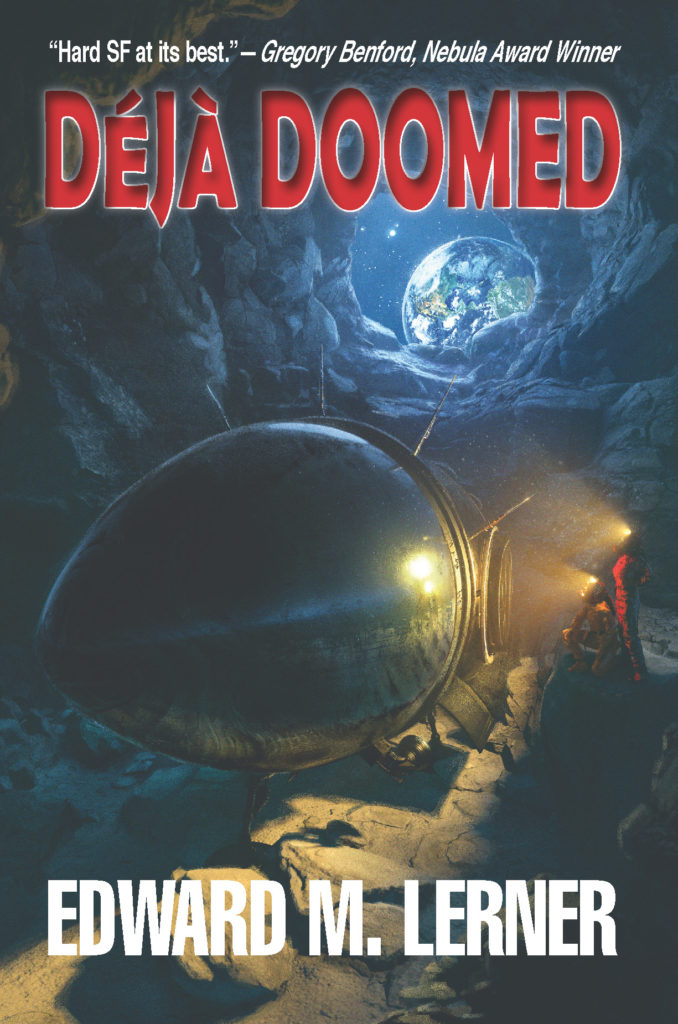
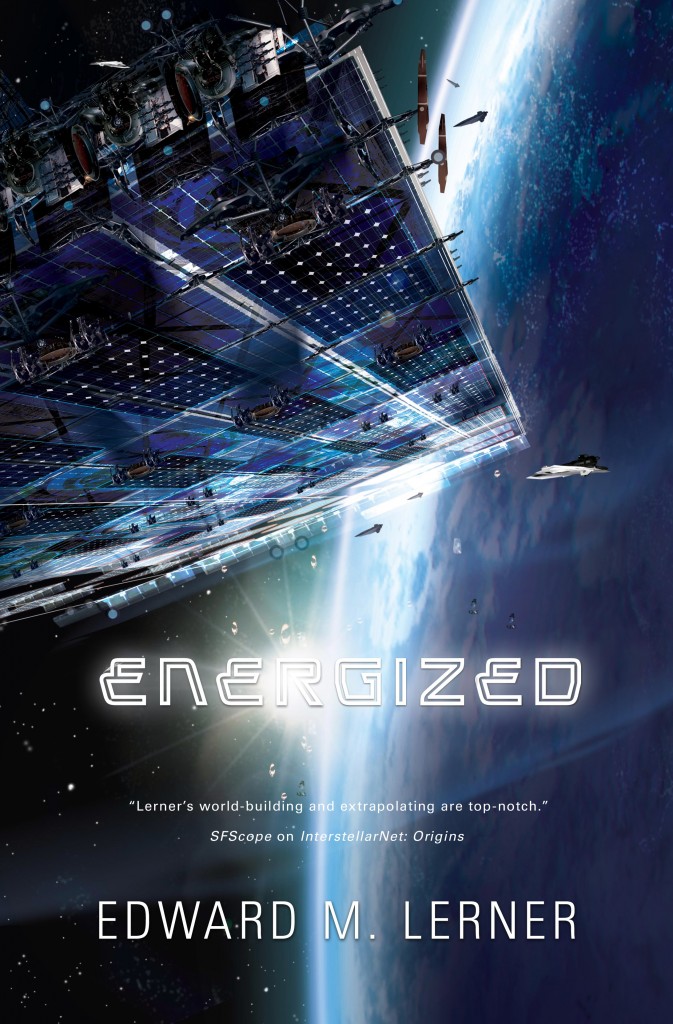
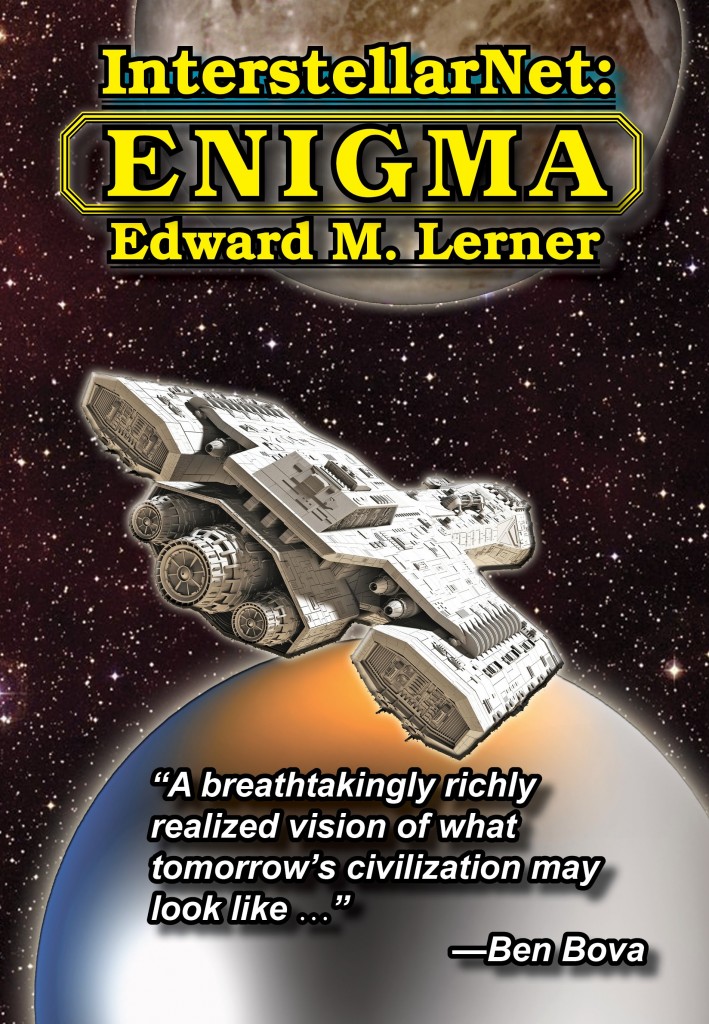
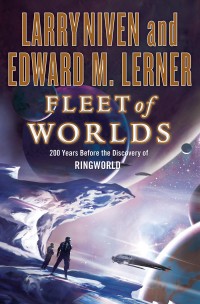
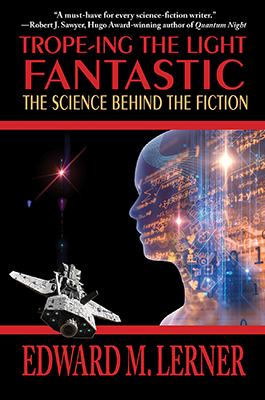
An hour-long conversation with Edward M. Lerner, Canopus Award-winning and Locus, Prometheus, and Hugo Award-nominated author of space opera, near-future technothrillers, and non-fiction.
Edward M. Lerner worked in high tech and aerospace for thirty years, as everything from engineer to senior vice president, for much of that time writing science fiction as his hobby. Since 2004 he has written full-time.
His novels range from near-future techno-thrillers, like Small Miracles and Energized, to traditional SF, like Dark Secret and his InterstellarNet series, to (collaborating with Larry Niven) the space-opera epic Fleet of Worlds series. Lerner’s 2015 novel, InterstellarNet: Enigma, won the inaugural Canopus Award “honoring excellence in interstellar writing.” His fiction has also been nominated for Locus, Prometheus, and Hugo awards. His most recent novel is the SF adventure Déjà Doomed.
Lerner’s short fiction has appeared in anthologies, collections, and many of the usual SF magazines and websites. He also writes about science and technology, notably including Trope‑ing the Light Fantastic: The Science Behind the Fiction.
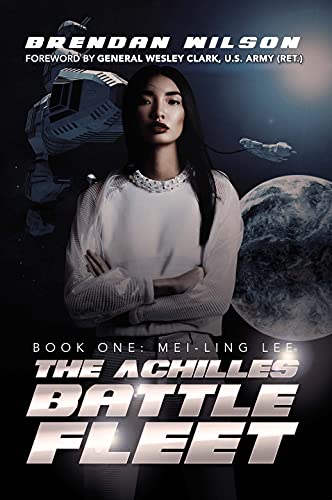
An hour-long interview with Brendan Wilson, former Army ranger and paratrooper and NATO defense planner and diplomat, master martial artist, and author of The Achilles Battle Fleet, Book 1 in the Mei Ling Lee Trilogy.
Following 25 years of military service as a US Army ranger and paratrooper, Brendan Wilson retired as a lieutenant colonel and then joined NATO where he served as a defense planner and diplomat for the next 15 years. During the course of his 40 years of work as a soldier and diplomat, he saw service in war-torn Libya, Ukraine, Kosovo, Bosnia, and Iraq. A former coach and team captain for a military martial arts competition team, he holds master ranking (8th Dan) in three different martial arts, and won the silver medal in the 2009 US Open for Taekwondo.
In retirement Wilson turned his efforts to filmmaking. He wrote and produced two award-winning short films (Doug’s Christmas, A Child Lies Here) and served as executive producer for ten episodes of the award-winning web series, Greetings! From Prisonstarring SNL’s Chris Redd. Moved by seeing human lives upended in war-torn areas, Wilson is earning his law degree and, once qualified as an attorney, plans to volunteer to help refugees. A former assistant professor who taught military history and the Univerity of Colorado, Wilson holds a Ph.D. in international relations and has about a dozen publications on defense-related topics. He is the father of two adult children.
Wilson lives a quiet life in Sycamore, Illinois. He spends his days writing, hiking, studying law and practicing his martial arts. The Achilles Battle Fleet, the first book in the Mei-Ling Lee Trilogy, is his first novel.
The First Novel of the Mei-Ling Lee Trilogy
Naval Academy martial arts champion Lieutenant Mei-Ling Lee serves in a backwater assignment as an aide to the inspector general of a rag-tag group of starships thrown together as a convoy evacuating civilians from a contested area of the galaxy. When the convoy is attacked, she finds herself thrust into the center of a galactic struggle as the chief of staff for the newly formed Achilles Battle Fleet. As the conflict continues, Lee is forced to draw upon her martial arts skill and her inner strength as she fights alongside the Fleet’s marine commando unit. Struggling with budding romance, new friendships and startling betrayals, Lee becomes the warrior she was meant to be.
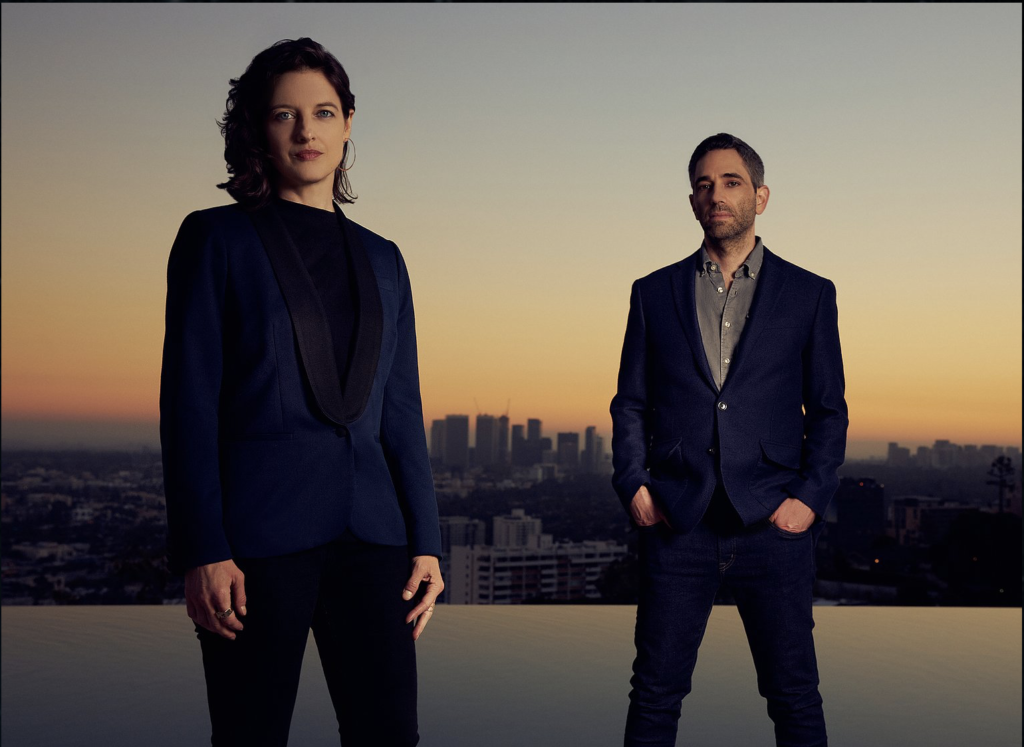
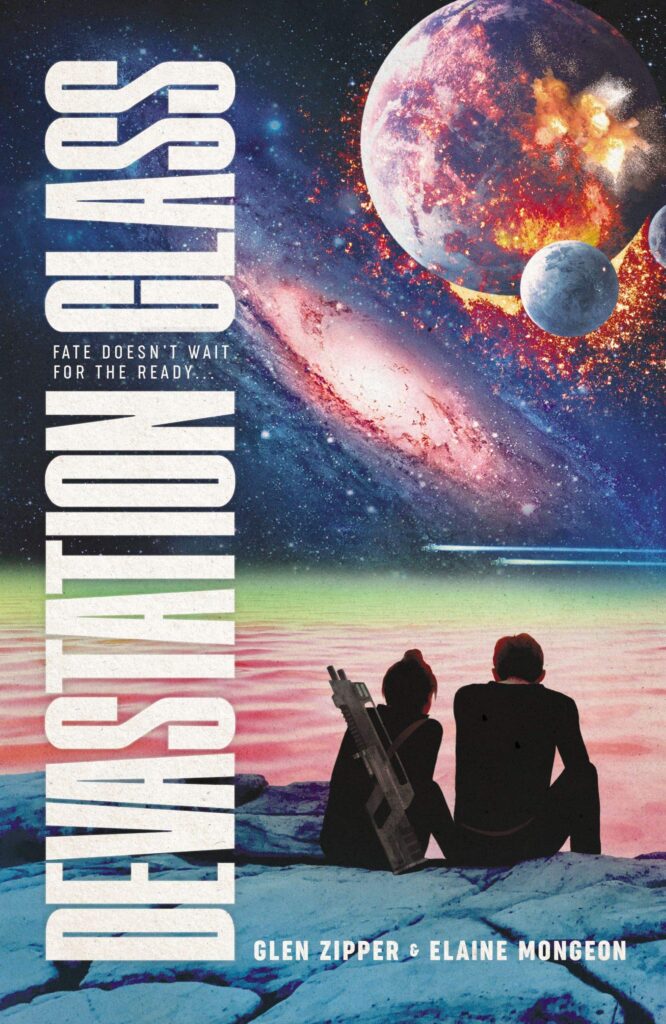
An hour-long conversation with Elaine Mongeon and Glen Zipper, filmmakers, screenwriters, and authors of the new young-adult space-opera novel Devastation Class, first book in a trilogy from Blink.
Award-winning filmmaker Elaine Mongeon wrote and directed the short films Good Morning for Warner Bros. Pictures and Swiped to Death for Hulu and the Sundance Institute. She also served as an associate producer on Magic Mike XXL. Elaine has a love for the outdoors and has been known to spend her time traversing glaciers in Canada and precision motorcycle riding. Originally from New England, she currently resides in Los Angeles.
Glen Zipper is producer of the Oscar-winning documentary Undefeated, and the popular Netflix series Dogs, which was greenlit for a second season, as developed and co-produced the recent Netflix hit docuseries Challenger: The Final Flight. He is also known for producing the HBO film Showbiz Kids directed by Alex Winter of the hit franchise Bill and Ted and is producer of the Emmy Award-nominated and Critics Choice Awards-winning HBO series What’s My Name | Muhammad Ali. Born in New York City and raised in Fort Lee, NJ, Glen currently resides in Los Angeles, where he enjoys motorcycle riding and stopping to pet every dog he sees.
The (Lightly Edited) Transcript
So, Glenn, Elaine, welcome to The World Shapers.
Thanks so much for having us.
And now this will be an interesting one. I have not done two co-authors at once. I have done co-authors, but I did them as separate episodes. So, we’ll see how this goes.
We’ll still follow the same procedure, I should say, first, usually I say, oh, we met at some convention or something. But no, we’ve never met in person. So, this is all new territory for me. We’ll start as I always start, which is taking you back into the mists of time and find out how each of you—and we’ll have to trade this back and forth a bit—how each of you, where you grew up and that sort of thing, basic biographical information, but how you got interested in storytelling. You’re both filmmakers now. You’ve written a novel. Was there writing and books involved in your early interest in science fiction fantasy, or where did that all come from? So why don’t we start with Elaine?
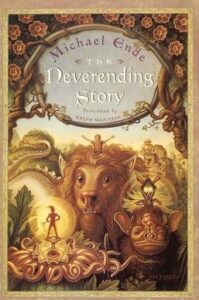
E: OK, well, so from a very early age, my mom would encourage my siblings and me to tell stories. Basically, from the time we could talk, we’d tell the stories, and she’d write them down and draw the pictures. And then, once we could write and draw, she encouraged us to write and illustrate our own storybooks. She is a writer herself and an English teacher, and, you know, she just really encouraged us to explore our imaginations. And then, my older brother and sister, who were eight and ten years older than me, they really introduced me to sci-fi and fantasy. I was reading things like The Neverending Story and The Lord of the Rings and then progressed to things like The Stand, when I was much too young to be reading stuff like that. But movies really played a big part, movies and series in introducing me to sci-fi and growing my love of it, just, you know, Star Wars, the original Superman movies, Mad Max, the Alien movies, Blade Runner, all of these movies that I probably shouldn’t have been watching. So, that’s kind of how it all started.
And, you know, I would write privately because my mom never stopped encouraging us to write. And then, in high school, my English teacher was sort of the first person other than my mom to encourage me to keep writing creatively. And then I went on to college, originally as a bio/pre-med major, because I never actually thought that I could, you know, develop my writing into something that I would do professionally. It was always just sort of something that I did for fun in my spare time. But I quickly realized that science wasn’t really the track that I wanted to be on. My mom actually…I called my mom in tears when I was in Chemistry 101, freshman year of college, and she said, “Get out of the class.” And I was like, “What do you mean?” And, you know, “This is my dream of becoming a doctor?” And she was like, “It’s OK,” you know, like, “You’re miserable. Do you really want to be this miserable for the next at least eight years of your life?” And so, she was very, very smart in, you know, supporting me and making the change. And I kind of floundered for a semester, and then she called and said, “B.U. has a film program. You love writing, you love movies. Your brother loved film school. Why not consider going to film school?” And again, you know, she just had this insight into, you know, kind of what I was not realizing for myself, which is that I’ve always been a storyteller, and I just never really thought of it as a practical whole. And so, I did the film school, and I got in, and I absolutely loved it. And that set me on the right course that eventually led me to L.A.
And, Glen, what’s your story?
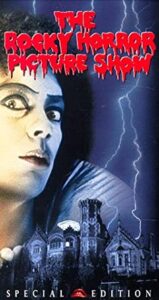
G: You know, I’ve been answering this question a lot in the last few weeks since the book got released. And I’m realizing that I’m getting free therapy as I answer the question, and some sort of working it out. And my answer is evolving as I’m coming closer and closer to the truth of where it all began, I think? For me, I had a relatively difficult childhood, like many other people, child of divorce, and there was a lot of stress going on in the family. And we had one of the first VCRs, top-loading VCR, and we had four we had four tapes. We had Star Wars, we had Superman, we had The Rocky Horror Picture Show, and we had a film called Where’s Papa? with George Segal and Ruth Gordon. And those, the confluence of those four films, I think, might have warped my mind a little bit. Star Wars and Superman, you know, a child’s brain could process. Then you go to Rocky Horror Picture Show, and I don’t know what that did to me, but it definitely did something. Where’s Papa? I didn’t totally understand. But when you’re that age, you look at TV, it’s not a TV, it’s a window. You think that what’s on the other side of it is real or some version of real. And when all the other chaos was going on in my life, that world, looking through that window, is what brought me comfort. And as you mature, as you get older and you start to come to terms with the fact that it’s not real and that the comfort of that imaginary world starts to go away because it’s it is imaginary, I think I just had this impulse to start creating my own world because if they lived inside my own head, they were somehow real, or more real. And as time went on, and I lived with these stories in my head, there’s yet another impulse that starts to take root, which is, “I want to share these stories.” They’re not going to be fully realized or fully real unless I bring them out into the world, unless other people can see them and touch them and be affected by them.
And for me, that started in film. But as a producer, you’re really just executing, helping other artists execute on their visions. I have a joke that I make, which is, “What does a producer do? A producer takes a director’s dream and makes it their nightmare.” And there is a lot of truth to that statement. Not that it’s an unpleasant thing to do, it’s a wonderful thing to do, but you . . . again, you are problem-solving for someone else. And it’s very . . . there’s not all that much direct creative energy that you’re able to put into something. So, between the process of, throughout my life, of coming up with these own stories and building these imaginary world in my head and at the same time being frustrated at not being able to tell my own stories as a producer, I think it was just a natural progression and evolution to wanting to write my own stories.
Now, writing scripts is different from writing prose. Had you done a lot of prose writing, either one of you, or had you been very much focused on scriptwriting?
G: Scriptwriting. But there’’s a funny story there, which is, Devastation Class initially was conceived as a television show because that’s what we knew how to do. And we wrote a pilot and wrote a few episodes, we wrote a bible, and we showed it to our TV and film connections and friends and colleagues. And the response was overwhelmingly positive, but as often happens in this business, overwhelmingly positive response does not necessarily lead to anything productive. “This is great,” but no one wanted to lift a finger to help us get this thing set up anywhere. And we languished with it for a minute, and then Elaine sent it to a friend who is an artist who does cover art for writing novels, and we wanted him just to read it as sort of a fanboy read to tell us if it passed his sniff test, and he read it, and he loved it, and he asked if he could show it to his, to a couple of editors at where he worked. And he showed it to them, and a couple of months later, they reached out to us very excited, and they asked us if we could write it as a novel, if we could write prose. And that’s when Elaine and I both decided that we needed to just lie a lot. “Yeah, 100 percent, we write prose all the time.” It’s not that, we do it for ourselves, and we never let anyone read it, but, you know, I had stacks and stacks of things I’ve written that I’ll never let the world see. But maybe this is the first thing that will write that we’ll let the world see. And so that sort of “fake it till you make it” moment is where the transition from TV to novel began.
Well, how did you two meet, and how did the collaboration begin?
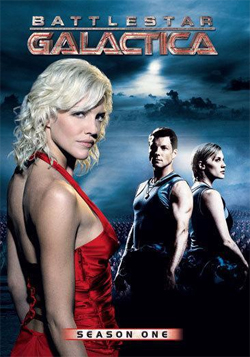
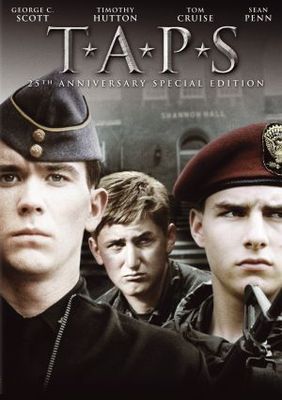
E: We met on an online dating site . . . it’s actually sort of a lifestyle website called nerve.com that had a personal section. And, you know, we met, we had a first date, the first day quickly turned into an overnight binge-watch of Battlestar Galactica, the Ron Moore version. Because we quickly discovered in hanging out that we had a lot of similar interests and mutual love of all things genre, specifically sci-fi. So, you know, we did this binge, and we were together probably for about a year or so when we decided that it would be really cool to collaborate on something together, and the original core idea that we came up with was “teenagers in space,” sort of aboard a starship, a sort of Lord of the Flies in the stars. And then the idea kind of grew from there. And we were actually inspired by this movie called Taps.
Yes. I saw I saw that. And I very much remember I’m old. I saw Taps when it first came out in the movie theater, I was probably . . it came out in what, ’81 or something like that.
G. Yeah.
So, I would have been about the same age as the characters—a little older, I was 22 in 1981, I guess, and had just started working as a newspaper reporter and editor. I have a very clear memory of Taps and how much I enjoyed it. And so, it was interesting to see that, and I can see the connection in the book. So, how did you come to Taps, though? I mean, it’s an old movie.
G. Yeah, it was, you know . . . I’m a bit younger than you, I was relatively young when it came out, I think I would have been about 10 or 11 years old. In the early days of HBO, they didn’t have very many movies. And so, what they would do was, they would take whatever movies they had, and they would just loop them, just one after the other after the other, and Taps was in that rotation. And so, even though I was probably too young to truly understand the sort of the implications of the movie and the themes of the movie, I became invested in that film after watching it so many times. And although we didn’t know who those actors were at the time because they weren’t quite that famous yet, we did have Tom Cruise and Sean Penn and Timothy Hutton, and it did have Giancarlo Esposito. And these are some remarkably powerful actors. So, even though they weren’t famous, their performances were remarkably effective. And I think that also left an impression on me. And it’s also a very jarring film. For those who haven’t seen it yet, I don’t want to give any spoilers away, but when you leave that film, it’s just one of those films that sticks with you for a while and feels like, a bit like a gut punch to the stomach. And so, I’m sure that that was part of the reason the film lingered with both of us for so long.
The divergence between Taps and Devastation Class is, in Taps, you had these military cadets who were students at a military academy, and they had a loyalty to the ideal behind the academy. And when the academy was threatened with being demolished to make way for some new condominiums, these cadets, they just couldn’t bear the thought of it, and they essentially mutiny and take control of the academy and try to prevent the construction crews from coming in and tearing down the academy. But that is a story about sort of an abstraction, a loyalty to an ideal. And you could look at that film and say, “Well, with these cadets did, really, their actions can’t be justified. The means don’t justify the ends here.” You know, the academy goes away, there’s some new condominiums that go up. Yeah. And so what? And to us, we said, “What if we took that to another level? What if the stakes were life and death? What if we had a group of cadets where if they didn’t take action, even though they weren’t permitted to, even though it would require a mutiny, if they didn’t take action, if they really believe that will need to their deaths and lead to the demise of perhaps even human civilization, what do you do now? And how do you handle the unforeseen consequences that come as a result of that decision?”
This might be a good point for a brief synopsis of the book for those who have not yet read it. Without giving anything away.
G. Sure. The story takes place in the very distant future after the conclusion of a devastating nine-year war with an alien race called the Kastazi. And in the aftermath of the war, humanity is having a bit of a renaissance, and instead of taking their battleships into space to fight aliens, they’re going on missions of science and learning. It’s peacetime. And because these battleships no longer have a war to fight and don’t need to be packed to the gills with soldiers, they’ve even taken students and young military cadets aboard these ships as they go on their missions of science and learning. And on one particular mission, on the flagship of humanity’s fleet, the alien race, the Kastazi, they return. A reinvasion force returns. And when the ship comes under attack, most of the adult officers are off the ship on a space station. And the few adult officers that are remaining on the ship are really not competent enough to save the lives of everyone that’s remaining on the ship. So, our cadets make the impossible decision to mutiny, to take over the ship, and to try and save themselves and everyone else. But after that happens, chaos is unleashed, and consequences that our characters never saw coming do manifest, and a mystery eons in the making starts to slowly become unraveled, which will ultimately lead to some pretty shocking surprises across the trilogy of books.
So, once you had the inspiration and once you decided that this was going to be a novel, what did your planning process look like? There’s two of you. You obviously would have had a lot of bouncing of ideas off of each other. Did you end up with a very detailed outline, or did you have a general idea and then just start writing? And how did that work for you?
E. Well, we were tasked, when we spoke with those editors who expressed interest in the story, they suggested that we write a book proposal.
You already had a serious proposal, right, like a series bible?
We did. Yeah, we had three episodes of the series written in script form. And then we had a bible for the rest of season one. So, we already had, you know, we had already structured out a lot of the story. Now, when we decided to make it into a novel, a lot of the original concept changed structurally, and characters changed, but for the most part, the bones stayed the same. So, we wrote about a hundred pages of prose, and then the rest of it was an outline, basically a synopsis of what the rest of the book was going to be. And because we lived together for a large portion of our relationship, we were constantly, or we were spending so much time together, we were constantly, in our free time—because we were both working our other jobs while we were doing this—we were really spending a lot of our free time just talking things through before pen ever went to paper and exploring other ideas and spending our weekend brunches, like, over eggs and pancakes, just talking a lot about where the story was going to take us and where these characters were going to go.
Did you have any major disagreements during that process about how it should proceed?
G. We did. We had a big one in the beginning, which was . . . we had initially started writing the book in the third person because there’s so much action that takes place parallel to other action in the story. And if you’re in the head of, or in the perspective of, one character, how do you see that? How do we get that across to the reader? How do we portray in an efficient way all these multiple storylines that are happening at the same time? And we gave it a crack, and we were probably a third of the way through the book, and I think we both instinctively knew that something wasn’t working. And I was more stubborn and wanted to stay in the third person, and Elaine was very dogged about wanting to give the first-person perspective a shot. And at some point, I got frustrated enough with her that I said, “Fine, just go do it, you go do it, and then you send it to me, and it’s going to be terrible, and then I’ll tell you it’s terrible, and then we’ll go back to the third person.” And so, she went away, she did that, she sent it to me, I opened it up, started reading it very angrily, like, “This is going to be terrible. I think this is . . . oh, this is actually excellent. Golly.” And then I had to admit that I was wrong, which I hate doing, and I’ve done maybe three or four times in my life, not any more than that. And we went back, and we changed the perspective, and it was all first-person, and it became a multiple-character book. So, we tell the story through the perspectives of various characters. And that was our way of being able to touch on the various storylines that are happening parallel to each one other at the same time.
Yeah, choosing the voices is always challenging. My current one is mostly first-person, but I did . . . it’s first-person with third person, is what I did, which was interesting.
E. Whoa. Wow.
And I did one years ago, before I was getting published, but when I was still feeling my way, I wrote an entire book in third person, and then I wrote it again from first person. And first-person, I think . . . I mean, your book, having only seen it in first person, it’s hard to imagine it in third person because the first person seems, you know, it’s very immediate, and you’re right in these kids’ heads. So, yeah, I think I think Elaine was right, Glen.
G. She was. It’s quite frustrating. And I’m just going to have to live with it. I’m in therapy, and I’m working through it. I’m getting a little bit better every day.
Well, once you had your outline, what did your actual writing process look like? You’re collaborating, are you writing, each person writing a chapter, then switching them back and forth? Or how did that work for you? And I’m presuming because you’re collaborating, that it was all done on computer. You’re not literally putting pen to paper, which is the expression Elaine used, but maybe. I don’t know.
E. No, no. Everything is definitely on the computer. You know, we have this joke that, like, people often envision is writing together, sitting at, like, a kitchen table with our laptops back to back as if we’re playing a game of Battleship. But that’s definitely not how we do it. Yeah, one of us will go off and write a handful of chapters and then send it off to the other person, and that person will take a stab at it, and we just kind of go back and forth until we’re both happy with how they’ve landed. And, you know, sometimes we have heated discussions about things that we disagree on, but I would say that along the way, a large percentage of the time, we are very much in agreement about, you know, what it should be.
So, one of the interesting things here, you’ve got a fairly complex world with various alien races. I love the fact that the Greys are an actual alien race, I thought that was very funny, and you’ve got, you know, spaceships, you’ve got to have to figure out how you’re going to, you know, how do they get around the galaxy? You have this Blink reactor, which is something else. You’ve got space stations. So, what kind of research and sort of that level of planning would you have to do? It’s kind of like, you know, in film terms, it’s like set design and set decoration and stuff like that. Did you have a lot of that kind of material worked out ahead of time, especially when you’re writing separately? You know, you want to make sure that one person’s version of the spaceship is the same length as the other one and has the same arrangement of rooms and things like that.
E. We actually, you know, for the actual ship of the California, we actually sat down one day and, like, talked it through and made a diagram of where things would be just . . . you know, I mean, neither one of us are our artists in that way, but a super crude drawing of where, of how to lay it out, just so that we could . . . you know, it’s much easier to envision where things are happening if you actually have it plotted out. So, I kind of remember looking at some maps of the galaxy online and then quickly abandoning the idea of being accurate because it’s so complex, you know . . .
And you’re in three dimensions, too, it’s not a two-dimensional world.
E. Exactly, so . . .
G. There’s also, you know . . . I think some of the influences are obvious in the book, and one of the primary ones would be Star Trek. And I remember at some point watching, it was a YouTube video of someone who worked on Star Trek and designed the technology and wrote the technobabble, and someone in the audience raised their hand, and they asked the question, they said, “Well, how does the transporter work?” And the Star Trek production person looked at that person and said, “Very well, thank you.” And I sort of took it the heart, you know, and we also, as we were writing the book, we were thinking about, you know, what if someone like Neil deGrasse Tyson read the book and tweeted out, like, “Well, that’s not how something would operate in space.” But our answer to that would be, “Are you really sure this book is happening in space?”
Well, and there’s a lot more freedom with a far-future tale than there is, if you’re trying to do, you know, Gravity or something like that, which looked good, but apparently was really quite wrong in many ways.
G. Yeah.
But when you’re dealing with the far future, of course, you could say, “Well, yeah, we have artificial gravity, and why do we have artificial gravity? Well, because it’s really hard to tell a story where everybody floats around all the time.”
E. Yeah, exactly. Yes.
And that’s a long history in science fiction with space drives, right, hyperspace and folding space and time, because otherwise you just can’t tell the story you want to tell.
G. Exactly.
E. Exactly.
What about characters? How did you find the characters you wanted, and how did how do you build up and design your characters?
G. I think there is an inevitable impulse to imbue yourself into these characters somewhat. We all like to see ourselves as the protagonist. Even when we’re watching a film that we love, we see. . . you’re watching Star Wars, you sort of see yourself in Luke Skywalker, and you see yourself in Princess Leia, even though that is ridiculous, you just inevitably do that. At some point, we realized that we were probably doing that a bit too much because we have arguments, like, Elaine would say, “Well, JD would never do that.” And I would say, “What do you mean you wouldn’t do that? I am him. And that’s exactly what I would do.” And then she would look at me and say, “You’re not him. “And she was right because he’s far more talented, far more proficient in everything he does than anything I do. Probably the more accurate component or portrayal of ourselves in these characters are in their flaws and their insecurities and their doubts. So, in that sense, a part of us lives in all these characters.
Another interesting influence for us, if you noticed, the book is dedicated in part to our dog, who sadly left us last December after being with me for 17 years. But his loyalty, his love, his tenaciousness, his fierceness. You know, he was sitting at our feet the whole time we were writing this book, and he was an omnipresent reminder about the best qualities that we could hope for any of these characters to have. And so, there’s a part of him that that lives in each of these characters.
And then also, we both have an affinity for all things 1980s, particularly 1980s films like John Hughes films. And if you look at those films, many of them were ensembles with teenage characters from every walk of life. And, you know, if you watch those films, you always pick a character that you identify with more than some of the others. And we wanted this book to have some of that as well, which is also why we were very careful to not be too particular in the way that we describe the physical appearance of these characters because we didn’t want there to be a bar to entry in that identification. We wanted someone reading the book who identified with JD or Viv or Anatoly or Safieh or Ohno to say, “Oh yeah, that’s me. That’s my character in this book. So, I think, if you take all those factors and put them into a bag, that’s really the origin story from where these characters came from.
You started with teenagers right off the bat, when you first started this idea, what drew you to a teen story where the characters are young?
G. Because it helped with the stakes, because they’re not yet equipped to solve even the most basic problem sometimes. We would submit drafts to our editor, and a note that we got back often and that we found frustrating was, like, “Why did they make this decision? It’s stupid.” And we’d be like, “You remember when you were a kid and all the stupid decisions that you made?” And, you know, we were making stupid decisions as kids, sort of like, maybe, we drove the car too fast, or maybe we broke the lamp, and we lied about it. We didn’t have life and death stakes. We didn’t have the fate of the universe on our shoulders. And, so imagine how difficult it is for someone in the position of these characters who are 17, 18 years old, to have to navigate the stakes of the universe imploding upon them.And to us, that was much more interesting than 40-year-olds, 30-year-olds, who have some life experience, have navigated some serious landmines in their time, it’s just that juxtaposition of, those who are not ready who have to take on something that, if they were to just stand down, would probably result in their demise. That’s why the tag line of the book is “Fate Doesn’t Wait for the Ready.”
Yeah, I think that’s what draws many people to YA, both as authors and as readers. And, I mean, even adults read a lot of YA. I’ve written quite a bit of who I am. I have a trilogy called The Masks of Aygrima with a fifteen-year-old protagonist. And I would see reviews that say, “She keeps doing stupid things.” And I said, “She’s a 15-year-old girl. Of course, she does stupid things!”
E. It’s so frustrating, so frustrating. We feel your pain.
Now, you are scriptwriters first, and then you’ve come to prose. So, what differences did you find in writing prose as opposed to writing scripts? Obviously, there’s more description and maybe less dialogue, but other than that . .
E. Well, you know, with prose, you’re not limited by the sort of parameters that you have to follow within film and television. You know, we didn’t have to conform to a certain page length, for instance. We didn’t have worry about a budget.
There’s a famous story there that you may have heard. Star Trek’s episode. City on the Edge of Forever, Harlan Ellison’s original script had, like, this huge valley with giant statues looming over it, stretching off into the distance. And at the end, it was a, you know, a plaster rock with a hole in the middle of it showing old newsreel footage.
E. Yeah.
G. The ability to, going back to the first-person perspective, there is the ability to be in somebody’s head. Whereas, if you were going to do that in a film or TV show, really the only way to do that is through narration, which is really hard to do well without it being boring, without it feeling like it’s a crutch. We’re like, “Oh, we couldn’t, we’re afraid the audience doesn’t understand this. So, we’re going to have, we’re going to have a narrator sort of connect the dots for us. You know, famously, the Harrison Ford, the version of Blade Runnerwhere Harrison Ford is narrating everything you’re seeing, which isn’t very good, at least in my opinion.
E. Agreed.
G. And so, but when you’re writing prose, it does make sense. It doesn’t feel like a crutch. It doesn’t feel like you’re connecting dots for the audience that they otherwise wouldn’t be able to connect themselves. Instead, it feels like you’re offering the audience an intimacy with these characters that they wouldn’t otherwise have. And when you have that level of intimacy with characters, it’s much easier to invest yourselves in them. And that’s the formula for storytelling in our minds: characters you’re invested in, who go on a journey with stakes that are somehow paid off in the end.
On the other side, what . . . I mean, that’s a change. What advantages do you think being a scriptwriter first brought to your prose writing?
G. Efficiency, because in the end, you write a script, anything longer than 90 pages is hard for people to get through. I mean, like, the people who read scripts, you know, they usually go home over the weekend with seven or eight scripts that they need to read. And it basically destroys your entire weekend. It’s like, you can’t read that many scripts over a weekend and have a sort of personal or social life. And so, I remember, back in the day when I had to read scripts, when I would open up a script, and it was 120 pages, I would be like, “Come on, man, there’s no reason . . . like, why? You can tell this story in 90 pages. Why are you expecting me to read these extra 30? And so, we had to constrain ourselves to the same limitations when we would write in screenplay format. And so, you develop the tools and the skills to have an efficiency in storytelling, to be able to tell your story more clearly and with less runway. And also, without the crutch of being in someone’s head, you have to learn how to connect the dots through action, to have things make sense without your characters literally talking to you and telling you why they’re doing what they’re doing. And I think if you take those skills and you apply them to the prose, it allows for the same sort of efficiency. And then, you have to remind yourself to take the governor off and to allow yourself to go a little bit deeper, to let go of some of those efficiencies.
Do you think that there’s a better grasp of pacing, perhaps, than you see in some prose?
I mean, I don’t know how to answer that question without sounding like patting ourselves on the back, but I think so. But I think that could also be a criticism of the book, where someone will say, you know, “Why didn’t we get more time to sort of live inside these characters’ heads, get to know them, be more in tune with their inner dialogue? Why does it have to be sweaty action from chapter to chapter to chapter?” And we just made the choice early on that’s the sort of storytelling we wanted to engage in, where we wanted this book to feel like. Like, an action movie in a book. We never had the ambition for it to literally be Lord of the Flies or anything of that ambition. We just wanted people to read this book and have a tremendous amount of fun with it. And then when they were finished, kind of feel exhausted in the best possible way.
I think there are . . .whenever you writing a book, you’re writing for different readers, some readers will like the choice you made and some won’t. You can’t satisfy everybody—unlike in film where, you know, everybody loves every film. So, Elaine, you’ve done directing, and maybe Glenn, you have, too. I’m a stage actor myself, and I’ve directed and written plays. And I’ve . . . when I talk to people who have some theatrical or filmmaking experience, one of the things that it seems to me is that . . . I feel like I have a really good grasp in my head of where people are in relationship to each other. When I’m doing action scenes like, I know where they are in the room and where they have to go to to make something happen. Do you feel that perhaps your directing background helped with some of this on-the-page action as opposed to on-the-screen action?
E. Yeah, I would say so. I mean, you know, just having the ability to visualize people within a certain space. And, you know, I think that both Glen and I, because of our, even just, love of movies, really brought that eye toward a cinematic representation of, you know, when we’re describing what people are doing and describing the action, we really wanted it to feel cinematic overall. And I only directed for the very first time in a real way three years ago. And by that point, were already well into, you know, heavily into the book. So, I think, you know, the book helped the directing in many ways, and the directing helped the writing of the book. It kind of goes hand in hand, I think.
How long did it take you to write the version that you considered completed?
G. We’ve struggled with answering that question because we’ve done so many iterations, we don’t really know when it started, you know, because we had that first version of it that was a television pilot and then three episodes, and we did the book proposal, and then we made the revision from third person to first person. And so, where we settled is that writing the book proper was probably about four years or so. And a lot of that also . . . and this is a trilogy, so there were elements to the story that we pulled out that we are saving for subsequent installments of the book. And so, we weren’t just writing one book, we were writing three books, so that four-year time frame is a bit non-representative as it relates to one book, because we weren’t just writing one book.
Plus, you were doing other things at the same time.
E. A lot of other things. Yeah, a lot of other things. And I can add that we . . . there was a practical element to sort of the timeline, just because we had changes in editors at one point, so, you know, you kind of bring somebody else into the fold to have those creative conversations and things shift a bit. So . . .
That kind of leads to the next question, which is the revision and an editorial process. Did you write a complete draft, and then you were showing it to the editor or did . . . it sounded like maybe you had input along the way? Since they had come to you and asked for this.
G. Yeah, I mean, there was some back and forth. We did definitely show them components of the book before it was completed . . .
E. We also didn’t end up selling it to the original people that were interested.
Oh, really?
E. Yeah, which is really interesting. They kind of wanted . . .it turned out they wanted more of a heavily romantic element, and we weren’t interested in, like, in diving into that. Yeah, so we ended up at a different place, actually.
Did you show it to other people along the way? I mean, many authors use what are often called beta readers, sometimes alpha readers, people who read it before it’s finished and give feedback. Did you have anybody like that, like friends or colleagues that you shared it with along the way?
E. No, we really didn’t. We shared it with our agent, Charlie Olson at Inkwell, who’s been with us from the very beginning, and I think Glen and I both felt like, because we had each other to bounce things off of, we didn’t really . . .you know, it can get a little murky and sometimes messy when you have too many people kind of weighing in. So, we kind of just wanted to keep it limited, you know, with the exception of that very early decision to share it as the TV version just to kind of get like that, “Yeah, this is good,” reaction. We really kept it to a small, small circle.
It’s interesting because I read acknowledgments in many books, and there are so many people that are, like, “And thank you to all these edits,” and it’s like ten people that pre-read and gave feedback. And I was like, “Wow, you know, like we didn’t do that at all.”
Yeah, it’s interesting. Well, one of the things about this podcast is,
I talk to authors, bestsellers, and everybody does it differently. And many people have beta readers, but others don’t. I never have, partly from growing up in a small town. There just wasn’t . . . the writers’ group in my town, in Weyburn, Saskatchewan, was elderly women who wrote stories about the Depression, so . . .
E. Wow.
And I was writing science fiction and fantasy, and it just wasn’t a good match.
E. Yeah.
So, I just never got used to that. My stuff, I write it, and I send it to my editor, and that’s, she’s the first person that sees it, so . . .
G. It’s really interesting, because we do a lot of this in film, too, where we test stuff before we . . . if we’re making something from Netflix, we’ll have a friends-and-family screening, and you’ll get feedback from people. I’m always sort of on the fence about if it’s a good idea at all because when you ask people for criticism, you know, they’re
loathe to just say, “Yeah, it’s great, don’t change a thing.” They feel like they’re required to give you some sort of criticism. And there’s also . . . ego comes into it. So, like, if they don’t make suggestions for how to make it better, they haven’t left their imprint on your work. And so, it’s really hard to cut through it all and decide which notes to take and which notes to dispense. And really, the only way, in my experience, to figure out which notes are truly legitimate from other notes that are just someone imposing their own creative, you know, feelings on something, telling you the story that they would write if they were writing it, is to get a tremendous amount of feedback, because then you could say, “What are the notes that that keep coming up again and again and again, by different people consistently?” because that’s probably an issue that needs to be addressed. The thing is, a book is so personal that I wouldn’t feel comfortable showing an unfinished draft to 40 people. So, it’s a bit of a Catch-22.
That is one of the freeing things about writing a book as opposed to working . . . and again, my experience is more in theatre. Everything is very collaborative, maybe not, probably not, as much in theatre as it is in film and television. Whereas with a book, it’s really just, you ultimately get the final say—maybe the editor, yeah, but you don’t have to necessarily take anybody’s advice if you don’t want to while you’re writing it. Was that freeing?
E. It was freeing, for sure. I mean, you know, I love the collaborative nature of filmmaking. It’s one of my favorite parts of the process, is you bringing together all of these tremendously talented people to contribute toward this one goal. But it was definitely nice to just kind of have it be us, you know, figuring it out and working through it and exploring our imaginations. Just us.
Once you did submit it to the publisher, what kind of editorial feedback came back? Were there specific things you needed to work on that you had perhaps not worked on until the editor said, “Hm . . .”?
E. I think one thing that came up early on in the editorial process that we at first were, I think, a little reluctant to . . . and then ultimately decided it was a very good idea . . .was adding the perspective of one of the students, which we hadn’t done. We had only had the cadets’ perspective. And that was a really important contribution from our editor that we think, you know, we feel really improved the storytelling because we were really able to present both sides. And, you know, that was key. Glen, can you think of anything else that may have . . .?
G. I think that’s probably the big one.
E. You want to talk about Bossa a little bit?
G. Well, yeah, well, I mean, it actually might be something that I think was an editorial feedback that we got that we, if we can do it all over again, we would have rejected, which was . . . there is another character in the book, named Bossa, who is an outsider, a bit of a space pirate, who comes into the story and sort of unsettles things. And we had his perspective in the book. And our first editor just didn’t didn’t think it was appropriate to have his perspective in the book. And he was a bit of a, certainly a lighter character in terms of his perspective. Certainly not a light character, but he definitely had an irascible spirit about him, or does have an irascible spirit about him, and was just really fun to write. And we ultimately took that note, and we did remove his perspective from book one. But, oh, he’s going to be all over book two, his perspective, from beginning to end.
E. Yeah, we’re really excited about that.
So, you did envision this as a trilogy from the very beginning?
G. Yes.
E. Yes.
That’s helpful because then you can, as you said, you can pull things out and say, “We’ll use this in the next book.” It’s when you write one, and then they say, hey, let’s make it a trilogy, and you didn’t really plan for that that you sometimes . . .
G. And it gave us the opportunity to plant a lot of fun Easter eggs in the book. And they’re not easy to find, but once people read book, too, it’ll pay off, and they’ll say, “Wow, I didn’t notice that those elements were living in book one all along. How did I miss them?
Well, the book is out now, as we are doing this conversation, and it will have been out for quite a while by the time this goes live. Have you been pleased by the response you’re getting?
G. Yeah, I think we’re, like, we have five stars or . . .
E. We have.
G. . . . or close to five stars on Amazon, and we’re doing pretty well on Goodreads, which I find absolutely terrifying. People don’t hold back, the people who don’t like you on Goodreads, you sort of just want to go, “Hey, here’s my address, come to my house and repeat that to my face.”
Yeah, I’ve had one like that. More than one like that. Yeah.
E. Yeah, brutal.
So, do you read your reviews?
G. The good ones.
E. Yeah. Yeah.
G. You know, look. I have a series out right now on Netflix called Challenger: The Final Flight, about the Space Shuttle Challenger tragedy. It’s doing very well, you know, at something like 90 percent on Rotten Tomatoes, and it was the number two show on Netflix in the US last week. And so, it’s a big success. But you go on Twitter and there’s, like, some of the people are, like, “It’s too long,” and then there’s other people, “It’s too short.” You’re like, can you guys maybe get together and come back to us with the consensus? As you were saying earlier, you just can’t please everybody, and everyone does . . . the most frustrating thing I find about criticism is people don’t criticize you on your terms. Like, here’s a criticism of the book you wrote. The criticism is, “Here’s the story I wish you would have told.” Well, then you write that story. Tell me how you feel about the story that we wrote.
Well, and that brings us nicely to my big philosophical questions, here at the end, which is, “Why tell stories? Why are we, why are people in general driven to tell stories? Why are you particularly driven to tell stories and . . .and there was a third part to that, but I guess that will cover it. Yeah . . .oh, why stories of the fantastic in particular? Why go to science fiction and fantasy for storytelling? So those kind of three questions.
G. Well, I think that for science fiction, why science fiction, It’s because of the possibilities. There’s no limit other than the limit of your imagination. And also, when you are telling stories that have a component that are a bit like eating vegetables, you’re trying to get across important themes, you can sort of hide the chocolate in the popcorn when you’re telling stories in science fiction where people don’t really see those vegetables until they’ve finished the meal and then it resonates with them afterwards. In terms of why tell stories to begin with, I think as storytellers, we just enjoy that feeling of affecting people. By being able to create something and see the emotional response, you know, it’s sort of a call-and-response, where we create something that has some sort of endorphin response in them, which then, in turn, gives us a satisfying endorphin response of our own. And that back and forth in storytelling and telling stories is why I do it.
Elaine?
Yeah, and, you know, I feel . . . I agree with all of that and feel the same way, and I also think that there’s just a certain element of magic to storytelling overall. You know, I think that it’s this process of word by word expressing yourself onto a page, like literally grabbing something out of your brain and making a complete thought of it, and then being able to share that with other people and have them react and respond and entertained by it. And, you know, that process, while it can be grueling, it can be a very grueling process, it can be . . . it’s also tremendously satisfying. And, you know, the joy of being able to complete a project, you know. It was interesting for Glen and me to deliver this book amidst the pandemic. We handed in, we finally handed in the final version of it, and it was like, “This feels like we should be, like, jumping up and down and, like, having celebratory drinks.” And instead, we’re both in our individual houses, like, you know, just like, “Congratulations, we did it!” You know, it’s like this, you know, you’re confined to your own space during this strange time that we’re living in. But, yeah, I just go back to the magic and, you know, Glenn says there are just so many possibilities with sci-fi, you know, and I say there are no rules, you know. And I think that that also translates to, the magic of it all translates to filmmaking, as well. You know, when I finally had the experience of directing for the first time a few years ago, I went into it thinking, “I’ve been wanting to do this for such a large portion of my life. Oh, my God, what happens if I hate it?” And then on day one of production, the first time I gave the actors some feedback, and they adjusted their performance, and it was perfection, I literally yelled, “This is like magic!” after the take. And I think that that can be applied to novel writing as well, where you’re talking to people, and they are totally getting what you were trying to do. We, like, they . . . some people are noticing . . . I think the first time we had an interview where somebody noticed some of the Easter eggs and were like, “Wait, is that going to come into play in book two? We were like, oh, cool!” Like, this is such a cool thing to have other people, you know, recognize these things that we’ve been trying so hard to achieve for so long.
So, is it easier to get a perfect performance out of an actor or out of a character that you’re writing in a novel?
E. Oh, my gosh. Are you kidding? Way easier. Way easier in the novel.
So, we’re just about out of time here. What are you working on now that you want to mention? I think I saw in a interview, Elaine, that you sometimes don’t like to talk about what you’re working on, but . . .
E. Yeah, I’m a little I’m a little superstitious. I can say that I’m working on a couple of scripted movie ideas that I’m excited about, but it’s so early on in the process that it’s kind of not worth talking about them in any detail. And, you know, we’re both working on book two, which is obviously very important. And Glen, what are you working on?
G. Uh, I’m working on my tan. Well, of course, you have book two, and we’re just about finishing up season two of Dogs on Netflix. Challenger: The Final Flight was released last week, and that was a collaboration between my company and Bad Robot. And we have this second Bad Robot collaboration that’s in production now that I can’t talk about. But we’re hoping that will premiere sometime in early 2021.
You know, there’s a publisher called Angry Robot. I always get them mixed up with Bad Robot. But they are two different things.
E. Oh, I didn’t know that.
I think I think they’re British. They’re called Angry Robot. They have a pretty funny Twitter presence. They’re always making robot jokes. Oh, and where can people find you online.
E. Well, we have a wonderful website, DevastationClass.com, and then I’m @ElaineMongeon on Instagram and @E_Mongeon on Twitter.
G. And I am @Zipper on Twitter and @GlenZipper on Instagram, with one N. And if you go to my Instagram, you’ll notice there’s not much there other than me posting at least one funny animal video a day. So, if you like funny animal videos, head on over to my Instagram account.
E. Oh, and we have we do have an Instagram account for the book as well, it’s @DevastationClassNovel.
Great. Well, I think that will just about do it. So, thanks to both of you so much for being on å. I enjoyed that. I hope you did too.
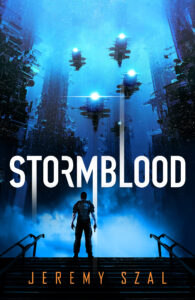
An hour-long conversation with Jeremy Szal, author of Stormblood, Book 1 in the dark space-opera Common trilogy (Gollancz), author of more than 40 science fiction short stories, and former editor of the Hugo-winning online audio magazine Starship Sofa.
Jeremy Szal was born in 1995 and, he says, “was raised by wild dingoes.” He spent his childhood exploring beaches, bookstores, “and the limits of people’s patience.”
He’s the author of more than 40 science fiction short stories, and his debut novel, Stormblood, a dark space opera, came out from Gollancz in June 2020 and is the first of a trilogy. He was the editor of the Hugo-winning Starship Sofa until 2020, and has a B.A. in film studies and creative writing from the University of New South Wales. He carves out a living in Sydney, Australia, with his family.
He loves watching weird movies, collecting boutique gins, exploring cities, cold weather, and dark humor.
The (Lightly Edited) Transcript
Welcome to The Worldshapers, Jeremy.
Thank you very much, Edward. Lovely to be here
Well, thanks so much for being on. I haven’t been able to finish your book, but I’ve delved into it enough to know that it looks really cool. So, I’m looking forward to talking with you about it. But before we do that, we will do…well, first of all, we should point out that we are talking across a vast expanse of the planet since I’m in Saskatchewan and you’re in… Sydney, is it?
Sydney, Australia, yeah. I think fourteen hours difference.
Fourteen hours.
Yeah.
So, he’s actually…you’re actually in the future, from my point of view.
I am in the future. It’s not too bad here, you know. Another day has dawned, we haven’t, you know, destroyed ourselves. Aliens haven’t invaded. Not yet. Yeah.
Well, that’s good to know. I can get up in the morning without fear then. So let’s start, as I always do with my guests, by taking you back into the…I’m going to put reverb on this someday…the mists of time, and find out how you, well, first of all, where you grew up, and how you got interested in science fiction, and how you got interested in writing. So, how did that all work for you?
Yeah, I grew up here in Sydney, Australia. I was always a reader, and I never really thought of genre in any particular fashion. I just read the books I liked reading. But when I was ten years old, we moved to Austria for a couple of years, basically to a small mountain village, because my dad’s from Poland and my uncle and grandfather had died in a very short period of time and he needed to go out and sort some things there.
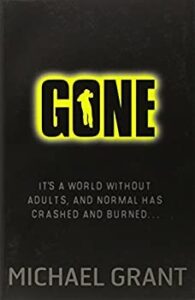
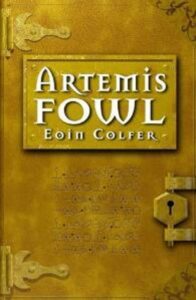
Anyway, so I’m living there in tall mountain regions of Austria. And for some reason, whatever reason, the local school library has a small English section. And, you know, obviously, they all speak German there. Alas, the world does not speak the language I speak wherever I go. You do have to learn the local tongue. And so, I hadn’t spoken German yet, and so I was still picking through what they had for me to read. And, you know, I quickly devoured a lot. But then, you know, my mother is an English teacher, and she was very, very determined to get me books. And so, whenever we would go to London, we’d always stop at the bookstore and I’d always, you know, devour whatever they had there. Like, I picked up whatever I still thought was interesting, you know, there was no, as I said, it was no genre, I didn’t think of fiction as science fiction or not. I just picked up whatever I wanted to pick up. And one of those things happened to be the Artemis Fowl series. And then I picked up the GONE series by Michael Grant. And then I picked up a few books by Stephen King. And again, I didn’t think of them…I just bought whatever I liked reading. And the covers appealed to me. I liked the action, I liked the adventure, I liked the weirdness of it.
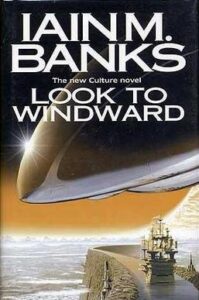
And then, I remember distinctly seeing a cover from Iain M. Banks when I walked into a Waterstones when I was thirteen, fourteen, and something about it just appealed to me, you know, the spaceship, the planet, the weirdness of it, the technology. And I couldn’t put my finger on it. Like, I couldn’t think, “OK, why do I like this?” I just did. You know, obviously I’d seen Star Wars, I’d seen my own fair share of science fiction, I was an avid videogamer, and so I had a little science fiction, but I never really thought of it as sci-fi. But then, when I came back to Australia and when I, you know, finished, started going into high school, I took up a few creative writing courses, and I found that I quite liked it.
And then, I started reading the whole Song of Ice and Fire series, when I was way, way too young to read those books. And then I saw the first season of Game of Thrones, again when I was way, way, way too young for it–I don’t even think I legally could have seen it at the time–and something about the whole idea of fantasy just appealed to me, you know, the idea of a magical realm with its dragons and creatures and these different cultures and different landscapes and all this weird stuff going on like that, this really appealed to me. And so, when I started acknowledging, you know, the idea of science fiction through video games like Halo and Mass Effect, it just really grabbed me. And so, when I did finish high school, I just started reading, going to the bookstores, and going to a science fiction bookstore, science fiction section of the bookstore, deliberately, like, I started picking up The Witcher books, I started picking up Brandon Sanderson, I started picking up Karen Travis, Greg Bear, a bunch of other people and, you know, as I say, the rest is history.
Well, you said that you took some creative writing classes in high school. Were you writing outside of class at the time? When did you start writing your own stories?
Yeah, it was probably earlier. I just basically parroted whatever the hell I was reading at the time, you know? And, you know, I didn’t really think of myself as a writer. I just thought of myself as someone who, you know, I liked typing, and so I just started getting it all down. I mean, like, I don’t even think it was, you know, anything remotely cohesive. I just, you know, did whatever jumped to mind. But then, when I was in high school, and I started taking those classes, I did start thinking of the idea of writing to be published, you know, writing to be read. And one of the things that did that was reading the adaptation of Halo, one of the video games, novelizations by Karen Travis. And I just…it was very, very little action, but it was a very human story. And I just found that I could visualize it very easily because I’d played the video games. And so, it just…I was able to pick it up very, very easily. And I had a very short attention span, so that was, you know, priceless. And so I started thinking, “Hell, I’d like to do this!” And so, yeah, I started doing it seriously. And when I did finish high school, I started pursuing it seriously.
But you didn’t actually study writing when you went on to university. You did film studies, right?
I did both. I did creative writing and film studies. I don’t actually think the creative writing was anywhere near as much help as the film studies thing was. I think the film studies really did hone in on the nature of craft and the nature of scriptwriting and the nature of pushing your characters forward, always intriguing the audience, always having something behind the next corner. A lot of the creative writing classes were, “OK, how do we allude to metaphysical imagery that this obscure 1920s writer was trying to get out, probably while he was depressed, high, and on his deathbed? How can we apply that to our own, you know, creative process, our own creative lives?” And, you know, I zoned out pretty early on in most classes. But the film study was quite educational. So, I think it’s very good to get a diverse range of inspirations.
I often ask people who have taken creative writing in university how helpful they found it for the kind of writing they ended up doing. And you just answered that. And I often get that, especially from people who write in science fiction and fantasy.
Yeah.
It’s just still not a genre that is particularly welcome at university creative-writing programs.
Absolutely not. I straight-up had one teacher tell me that any sort of science fiction, fantasy, anything like that, is just bad. And you could just hear a groan go around the audience, and some girl put her hand up and said, “Yeah, but why?” And I don’t remember the answer because I was too annoyed to pay attention.
But I do remember this one creative writing class where this one girl literally showed up to class with, not a story, she just pasted together all these newspaper clippings of various things that happened around the world and then wrote her own sub-stories about the Salem witch trials, but not really. And so, there were newspaper clippings on this big canvas sheet, like a collage. But the thing is that there was a massive bloodstain on it. And we’re all sitting there, thirty of us, looking at this bloodstain, and wondering who this, you know, ultra-Goth writer, this girl who, what she’d given us. And the teacher’s like, “Uh, what is this?” And she’s like, “Oh, yeah, I was cutting together all these newspaper clippings with a box cutter and accidently sliced my own fingers. And I started bleeding all over the pages. But I’ve decided, you know what? Instead of that, instead of just getting a new one, I’m just going to keep it.”
And I looked at the teacher, waiting for her to tear her down, and she’s like, “Oh, yeah, I can see there that there’s a bit of an arterial spray around the word ‘pain’, there’s a big, big splatter around the word ‘witch,’ there’s a big clump of hair and, you know, residue of nails and tissue right there around the words, the time, you know, and it’s like echoing back to the blood spilled by generations lost.” I almost flipped the table across. I’ve never been closer to picking up a chair and hitting someone with it in my life.
And because one of my friends at the time, she–who ended up ultimately beta reading Stormblood and is in the acknowledgments for Stormblood–she was a filmmaker, and she’d just come off making a short film that had been screened around the world. And a lot of the actors, some of the actors in the short film have gone on to do bigger things, like, one of the actresses, she’s in a movie, just finished a movie with Jason Clarke and Helen Mirren. And she’s in these, like, another TV show that’s going to be on HBO, and, you know. So, my friend basically helped discover her in short film. And so, we both of us had a background in what we were doing, a semi-professional background. So, we just looked at each other, and we were just boiling. And this other girl, of course, got top marks, for doing, like not even, she didn’t even do any writing. She just cut newspapers together and bled all over them. I think that, if nothing else, that summarizes what my experience at university was like.
Well, you’ve written a lot of short stories, and you’re not a particularly aged individual. So, when did you get started on the short stories, getting-published short stories,?
I think when I was 19, I started getting good news from short-fiction editors. The responses weren’t just, “No, we don’t want this,” The responses were, “This is interesting, but we’re going to pass.” And so, I kept sending them out and sending them out and sending them out, and eventually, one of them sold for actual money. And I was over the moon. I’m like, “OK, I’ve cracked the code. I actually can do this. There is actually a way for me to do this,” because, you know, if you look at that wall, that impenetrable wall between you and being a published writer, it looks unscalable. But now that I actually had done it, I’d actually reached out and found some measure of success, it boosted my confidence.
And so, I kept writing and kept writing and kept writing and I kept sending them out. And eventually, one of those stories, when I was 19, ended up selling to Nature magazine. So…and that was pretty amazing, for me to actually sell to a professional magazine published by Macmillan and to be able to have that, you know, see my story in print and know that it’s widely distributed all around the world. It was an incredible feeling and showed that I actually could do it. And so, yeah, I just kickstarted from there, and I kept writing short fiction over the years and getting them out, and I kept getting my stuff published. And it was, yeah, it was pretty interesting.
I still don’t think that I’m a good short-fiction writer, and I only say that because, as someone who has edited short fiction for about six years and has read thousands of thousands of stories, I think there’s a very, very, very specific sort of story that most short-fiction magazines want these days, all the sort of structure, the sort of style that they’re after. Short stories are not condensed novels. They’re not truncated novels. They’re not very, very quick stories. Short stories, I think, have a very, very specific sort of style to them, not just the way they’re written but the sort of writers that they appeal to. And that’s great, you know, the more, the merrier. But that sort of style generally isn’t for me. I say generally, because sometimes there’s a sort of freedom being able to just go wild and experiment with something, try a new POV, try a new setting, try any of that, you know, and I’m writing 180,000-word epic dark space operas, that are all from first person, voice-driven, and so sometimes it’s a relief to break away from that and just go crazy. But yeah, I don’t think I’ve quite cracked the sort of thing that most short-fiction readers and editors would like to read
I mean, if you look at something like Ted Cheung, he’s never written a novel, but he’s probably the best short-fiction writer living today. And he’s probably one of the only short-fiction writers, modern writers, who’s had his work adapted to an incredible film. That’s how good he is, not only how good his work is, but how widely it appeals, and that in itself is a skill. And I don’t think that’s something I have quite yet.
I did want to ask you about the editing for Starship Sofa. You’re both a short-fiction editor, but it’s also an audio…magazine, I guess. How has that fed into your own writing and the way that you work with words? Has it been…doing all that editing and reading those thousands of short stories, do you think that has benefited your own writing going forward? And also, how does the audio aspect of that fit in?
It absolutely has benefited me. I mean, it’s hard not to, because I’m reading all this fiction and, you know, you have to come to a conclusion. You know, there’s no, “I don’t know if I like this or not,” it’s, “Do I think this is something I want to buy and give money for? Do I want to accept this and be responsible for helping adapt it to audio and putting it on the podcast as something that I’ve edited? Do I want to work with this story?” The answer is yes or no. And in order to come to that conclusion, you have to look at a story, quote-unquote, “objectively,” and think, “OK, is it ticking the right boxes? Does it appeal to me? Do I like the genre? Do I find the style engaging? Do I want to keep reading? Do I like the ending? Do I like the approach that it’s taking?” You know, you do have to sit down and think, “Yes or no, this is something I want to read?” I mean, we’ve all read books that, we’re not quite sure we love them, but we kept reading them anyway. But doing the short fiction, I think, really helped me know, “OK, yes or no.” And one reason why I did that was, I’d read the first page, the first couple of pages, and think, “OK, do I want to continue.” And knowing, being able to say yes or no, would save me, not only so much time but so many headaches, because I’ve gotten fiction that’s made my eyes bleed, not literally bleed, but close to it, but thankfully that’s not the majority. The majority of the stuff is good, or it’s just OK. But, yeah, I would look at the fiction I was getting and make, come to a conclusion either way.
And it really helped me, I guess, nail down not only what I thought was engaging fiction, but what I liked, you know, “I like this!” And a lot of that…for a long time, I thought I was an epic-fantasy person. And now…I moved on kind of to cyberpunk, and then I started developing a taste for space opera. And so, being able to know that when I get something that was set in space or set in a future or set in an urban city, or something that, especially if it was first-person or especially if it was voice-driven, I’d always get excited, like, “Yes, this is my thing.” And knowing that helped me quantify my niche, I think. And that really helped me establish, “OK, this is the sort of thing that I’m into.” And so, when I’d be reading, I’d think, “OK, this is what I don’t do. And all this is a really good trick. This is a really good method of easing you into a universe.” And so, I did slowly accumulate knowledge in that way.
The last question, the answer to your next question, is slightly less interesting, I think. The audio version, the way it basically works, I read it, I decide if it is something that can be read aloud in audio, on top of whether if it’s a good story, I send it to a narrator, they do all the hard work of actually reading aloud the thing and editing it and cutting it together. They send it back to me, I just pop up on the show, I just pop it up to my the editor in chief, Tony, and he broadcasts it. That’s pretty much it.
How did you end up being the editor for Starship Sofa? How did you make that connection?
I think it was Neil Asher who shared a post by Tony C. Smith, the editor-in-chief at the time, and still is. The other guy had left…I don’t know why or whatever, I think just didn’t work there anymore, and so I just messaged him and said, “Hey, can I have the job?” And a short Skype interview later, I got the job. I wish everything in my life came to me as easily as that did.
You mentioned that, you know, sort of going through the different genres and seeing what you like. In your own short fiction, has it gone through various genres as well, or have you tended to write in one genre in your short fiction? Or subgenre, I should say?
Yeah, definitely. I think I started off very, very much sort of fantasy, a bit weird. Mythological sort of style, you know, like the sort of Skyrim, Game of Thrones-esque sort of low fantasy, Joe-Abercrombie-sort-of-style fantasy. And I still love Joe Abercrombie, but that’s not the sort of fiction I ever want to write. It’s just not me. And I think I did kind of develop more into cyberpunk, sort of New Age punk fiction, like China Mieville, Ian MacDonald, Paolo Bacigalupi, that sort of thing. But then I started, you know, getting more into space opera as I consumed, you know, Alastair Reynolds, Iain M. Banks, Peter Hamilton, that sort of thing. And I just felt, “OK, this is the sort of thing that I like.” And I thought, “OK, can I write this?” And of course, no one tells you what you can or cannot write. And so I thought, you know, I’m just going to take a stab at it. And I did.
But I found that short fiction was a little bit constrictive for the space opera genre, especially the sort of space opera that I wanted to write, and so I started developing it more into novels. And that’s more or less the trend. I think the transition that happened in late 2015, early 2016. I’d just come off writing an epic fantasy, a YA fantasy, that I absolutely loathed. I got about two-thirds of the way in, and I’m like, “I never want to read fantasy, write fantasy, ever again. I can’t stand it. This is not the sort of thing, that is not me,” because I go, you know, “OK, I just got rejected for a YA sci-fi novel and 50 percent of the rejections said, “YA sci-fi is a very hard sell,” like, “Science fiction is a hard sell, YA science fiction is an even harder sell.”
And I’d just come off reading Red Rising, and I thought, “You know, this is the sort of thing that I’d like to do.” But I was writing in a fantasy and I’m like, I felt trapped by the genre. And I thought, “You know, screw it. I’m just going to write whatever I want to write. If it sells, doesn’t sell, that’s fine.” I did look at the market a little bit and think, “OK, what’s the sort of thing that is appealing to agents?” And I’ve always loved crime, always loved murder mysteries, and I thought…I had the great, I had the barnstorming, original idea, “Hey, what if we had a murder mystery in space?” And so I wrote it, and I’m glad I did because I wrote that novel in three months, it was incredibly powerful for me to be able to just sit down every day, no matter what I had on, and just pour out a thousand words or two thousand words every single day. Just get it down. No thought of, you know, “Is this good? Is this not good?” I just thought, “I’ll come back and I’ll fix it later.” I just powered it down, punched it out, and in about three months, literally three months, I wrote a whole space-opera novel, and I must’ve done something right because a year later I got an agent with that novel. So, I’m very, very glad I did it. I did do that.
Now, it was that Stormblood or was that a novel before Stormblood?
That is a novel before Stormblood.
Because I didn’t think Stormblood was–it didn’t seem to be a mystery novel set in outer space.
No, it’s not. It was a previous one called The Rogue Galaxy. It was about, you know, the whole premise of it, basically, what if you were convicted for committing a murder you didn’t remember committing? And so that was…and you had to go to the other side of the galaxy to find that answer.
But no, I’d finished that. I’d written it in third person and about halfway through I’m like, “This would really work well in first,” because I was reading a lot of first-person fiction. And it was a little bit too late, and I thought, “OK, at the end, I’ll just go back and change it.” And when I did get to the end, I’m like, “OK, I can’t be bothered about changing it.” So I thought, “I’ll just write a novel,” I think about the end of that year, I decided to just punch out another novel. I mean, even if you do get an agent, having another project under your belt is always a good thing. Having another project, you know, in the percolator is, you know, it’s always good to keep those juices flowing.
And so I started writing in December, either November or December 2016, page one, chapter one of Stormblood. And I thought, you know, “What if we had, you know, a fiction that was very set in space, but it was also very voice-driven, it was first-person, it had an edge to it?” And that idea just appealed to me. And I wrote that first draft in six months, and I must have done something right because a year and a half later I sold it to Gollancz.
Well, this seems like a good place for you to give us a synopsis of it without giving away anything you don’t want to give away.
All right. Stormblood, yeah?
Yeah.
All right. OK, Stormblood. The basic premise is that the DNA of an extinct alien race is used as a drug, and it makes people addicted to adrenaline and aggression. And so, of course, this one empire injected it into those soldiers and got them to fight off a brutal invading empire. And, you know, all seemed well and good. You know, these soldiers are literally addicted to killing, they’re literally addicted to running headfirst into a bullet-storm. What could possibly go wrong?
Well, everything, because it’s permanent and the high didn’t stop when the enemy was over, and the high didn’t stop when the battle came to a close. And they also had these, all these soldiers restless and not knowing what to do with their own bodies. And it didn’t stop when the war was over, and they got sent home, and they had these tens of thousands of soldiers permanently addicted to being on a battlefield. And so, the main premise of this is that the main character is one of these soldiers, comes back from a war, you know, traumatized, ridden with PTSD, but looking for a way to get his life back together. Anyway, the main forces that injected the DNA into him, the Galactic Empire, whatever you’d like to call it, they call him back and say, “We need you to do something for us.” And he wants nothing to do with them, for obvious reasons, because they ruined his life. They lied to him. They’ve lied to millions of people, the cost of winning a war, but at great consequence. And he says, “Why should I talk to you?” And it turns out that his fellow soldiers, the ones that he knows and loves, are all being murdered, being killed off, being overdosed. And it turns out that his brother is the prime suspect. His estranged brother is the prime suspect.
And so, as the book unfolds, you find out his history, you find out his history with his brother, you found his history with his teammates, and their whole central conflict is that he was very, very close to his brother, they developed a very strong brotherhood, you know, when they were surviving together on a brutal backwater planet, when they were surviving an abusive father. And he transferred that same sense of brotherhood and camaraderie to fighting in a war where the only people who knew what it was like to have an alien organism actually, like, squirming around in your head and sniffing up your chest and sniffing up your backbone was to be with, and, you know, what it felt like to be in cover and see the enemy charging towards you and like, get excited, “Yes! There are people shooting at me,” to actually get an adrenaline spike. The only people who knew what that was like were his fellow soldiers. What it was like to want to be suicidal. And so, he developed a very, very strong personal relationship with them.
And he comes home, as I said, and finds out they’re being murdered, potentially by…his brothers are being murdered by his flesh-and-blood brother. And so, the whole central conflict is him keeping the balance between that, being able to hunt down his brothers’ killers while dealing with the fact that his own brother is murdering them. And, of course, because this wouldn’t be a good story without a central personal conflict, the more he investigates danger, the more addicted to adrenaline and aggression he gets. Because he’s been out of the war for a few years, so he’s able to control his body’s, able to control his urges, but, of course, when he’s going up against killers and a shadowy organization, that doesn’t quite work out. And so, the more confrontations he gets into, the more hyped up and the more dangerous he gets and the more dangerous his body gets. And so, there’s that balancing act of keep of trying to get this all done while still not going insane, basically.
Well, it’s a bit of a cliche question, but, you know, it’s still a legitimate one, where do you get your ideas? So what was the seed for this? Where did this the seed for this novel come from that then sprouted to do this trilogy?
Oh, it was just my original genius, just sitting in a dark room and just thinking at all. No, not at all. I borrow very, very heavily from cinema and gaming because I’m a very visual person. And so, the idea of a far-future society has always intrigued me, both in the ideas level and a visual level, to be able to go to some central city on a spaceship, you know, galactic skyscrapers, you know, kind of like Coruscant from Star Wars, and to go down in all these neon dark cities, on all these busy streets that are frantic with these different alien species and different spaceships. You know, that idea has always very, very much appealed to me. And so, I knew that I pretty much wanted to set my story in that sort of universe.
And one thing I found is that there was very little of a Star Wars-esque sort of fiction being written that is not tie-in. There’s a lot of, you get a lot of alien stories that are either first-contact stories or the stories that are basically war-driven stories, that these humans are fighting a war against these aliens, but there’s not quite as many stories about a future society where humans and aliens have, you know, have joined forces or, you know, there’s this multi-species society, like, sort of Mass Effect. And that’s my bread and butter of fiction, and there wasn’t quite as much a lot as I would have liked.
But, so, I wanted to write that, but then I thought, “OK, what about, you know, let’s make it a little bit weirder. You know, what if the idea of, you know, this, how will we people upgrade ourselves and what sort of modifications would we make?” And then I thought, “You know, what if the modifications we made were from the DNA of aliens, how would that work, and how would we grant ourselves with alien, you know, biometrics or whatever?” But then I thought, “Let’s make it a little bit more interesting. What’s the cost of that? Surely there has to be a cost.” And the cost was that it’s a drug and it makes you addicted to getting an adrenaline spike. It makes you addicted to your own body chemistry. And so, then I started developing the idea of a brother, of two brothers who had a very good relationship but then were estranged, and then started developing that relationship slowly as I wrote the book. But yeah, I am definitely a character-driven author. I am not a plot sort of guy. So, I definitely did combine the idea of this alien DNA with the idea of these two brothers and just mashed them together and just sort of went on from there.
Well, what did your planning process look like? You talked about developing the characters, as you wrote. Did you do a lot of outlining ahead of time or just…what did that look like for you?
That’s a pretty good question. I’m most fascinated by this question, as well, because it’s very hard to tell when you see a finished product, knowing what went into it.
And I get a lot of different answers.
Yeah, yeah. In my case, I outlined the broad strokes of it. I knew that I wanted to have this to happen and I wanted the antagonist to be doing this, and I wanted this sort of resolution midway, and I wanted to have this sort of scene, and I wanted to have this sort of arc, but more or less how I got slithered in between that, I pretty much just wrote on the go. But as I did that, I more or less figured out, “OK, this is not what I want to do.” And one of those things was one of the side characters. I’m like, “OK, I haven’t quite gotten his voice down. I haven’t quite gotten his approach, his personality,” and in order for me to write a character, I have to know the sort of person they are because who they are influences the behavior, the relationship, the dialogue. And I can’t just…you know, if I don’t get a concrete answer, it’s going to be wet clay. And so I went back a little bit and did a bit of character tweaking, but more or less, I just went, you know, started going from point to point and just weaseling my way through those points, deciding, “OK, this has happened, OK, how are they going to get to the next point?” And I just rocked up one day and decided, “You know, OK, they will do this, they’ll go here, they’ll do that.” But the broad strokes of the narrative, the big anchor points, were definitely outlined. And I think that comes from film, of all things, because I’ve said, I’m very inspired by film. And one of my favorite sort of films are films where I feel like the director has a very tight control over the narrative, over every shot, over every scene, of the emotion that you’re expected to get from every point in the film.
Like, I’m a very, very big fan of something like a film, like, for example, the film There Will Be Blood with Daniel Day-Lewis. You know, that film is so incredibly tight. You just know that every, behind the camera, he was in absolute control. Like, a director like Martin Scorsese or Christopher Nolan or Denis Villeneuve, you get like something like Blade Runner 2049. Like, this is what they want to do, and this is how we achieve this…they achieved exactly that. And so that sort of thing that I enjoy doing, being able to control my narrative.
Unfortunately, the human brain sometimes has other ideas. And as I’ve discovered with writing book two, and outlining book three, sometimes that doesn’t always go to plan. And so, sometimes being able to adapt and figure out, “OK, this is actually what I want to do.” I mean, you get to a certain point in the narrative, and you’re like, “Actually, my characters don’t want to do this. Well, I don’t want to do this.” Or, “I could think of something better.” And you have to adapt. You have to be able to go along with it. And I refuse to write anything that I don’t want to write because I feel like, “OK, the narrative needs it” or “this is what I planned.” I can’t do that. I need to be able to write something that I feel is what I want to write.
What does your actual writing process look like? Are you a fast writer, are you a slow writer? Do you use parchment under a tree in the backyard, or do you go to a coffee shop? How does it work for you?
No, I siphon the lifeblood of other authors’ dreams, and I distill that into pen and paper.
I should try that.
Well, I’m pretty sure that girl from university, I’m pretty sure she was doing that. No, what I do do is, I am a fast writer. I can do three thousand, four thousand, five thousand words a day. When I was writing Stormblood, that’s the sort of mileage that I was pounding out. I was doing approximately four thousand words a day. Sometimes only a few thousand of those words were good. Sometimes I would write a thousand words and all of them were good. I wish those days happened more frequently than they do.
But no, I do typically go to cafes because I have a studio apartment and I have a lot of things, all my books, all my games here, and a multitude of distractions, either from my dog or my family or anything else that comes along, take me away from my little world. And so, being able to go to a cafe…you know, for some reason being around screaming children and coffee and, you know, waiters and whatever, for that reason, somehow helps me to cope. You know, if I eat, it doesn’t matter what it is. If I’m away from home, I can write more easily than I can when I’m at home. And so, being able to go down to a beachside cafe near where I live and pound out three thousand, four thousand words, I go to the pub, pout out a few words there in the afternoon, it really does help me distill what I need to do. Editing is a little bit more tricky because I’m, as I said, I try to be in control of my craft, and so, being able to be at home and on my big monitor, I think, helps me more specifically. But being able to get out the raw words, nothing gets it out like I do when I’m going out to a cafe or going somewhere public. It really just helps me get those words down. And sometimes that’s just what you need to do, is to make a fiction work.
Yeah, I ask a lot of authors that, obviously, and I personally like to write outside somewhere when I can, hasn’t been a lot of that recently, but one of the things that I have found, and other authors have mentioned this to me, is that they’re fine with the wash of sound from a busy place but if you get a sort of a quieter place, but there’s somebody sitting close to you having a conversation with somebody else, those words can really interfere when they’re writing. At least, I find that. Are you able to just tune all that out in the background no matter what’s going on?
No, I definitely agree. Like, unless everything is so cluttered that it turns into a white noise, no, I can’t. If someone is having a conversation right next to me, it does filter in. I do have a very nice pair of noise-canceling headphones that I make very, very good use of.
That’s when I listen to music. Instrumental music, though, because words in the music are the same problem.
Yeah, exactly. Exactly the same. So I’ve just got this massive playlist of, you know, soundtracks, Hans Zimmer and John Johnson and Brian Eno and all these other great artists and great music soundtracks that really help me distill the sort of thing that I’m trying to write. It’s very, very useful.
You mentioned editing, so what does your revision process look like? Do you write straight through and then edit from start to finish? Do you do a rolling revision as you go? How do you work?
That’s an interesting question because working with an editor is far different than it is working, editing, self-editing your own project. And my editor is Gillian Redfearn at Gollancz. She edits Joe Abercrombie, Richard Morgan, Alastair Rennolds, Joe Hill, a bunch of other fantastic writers. So she very, very much knows her craft. So, the way that we did Stormblood one was that we edited the first half of the book once. Because we did structural changes. And so, she edited the first half of it, I went back, did my editing, made those changes. She looked at it, saw the sort of changes that I had made, and then edited the second half of the book to apply the ripple effects from the first half. So basically, the things that changed in the first half she then helped edit with those changes in mind for the second half.
And so, she basically edited the first half of the book twice, basically. And so, I’ve actually had to keep that in mind when I am writing, doing my editing, I’m thinking, OK, I kind of look at it as a concentric circle. “OK, what’re the big structural things that I’ve got to change? Is it character? Is it worldbuilding? Is it, you know, the big plot revelations.? What are the big things I’m changing?” You know, I’m not preoccupied with small things like one scene or, you know, chopping down an action scene, or at least I shouldn’t be. I’m trying to think of the big things. “OK, do I actually need an action scene here?” Because you can edit your life, your heart out of a scene, and this is actually applicable for something that I just did in book two. I had all these different plot points going on in those one scene that was taking up a lot of time, and it wasn’t getting too much. And so I’d wilt it down and wilt it down and wilt it down and chop it back, chop it back and chop it back, and it came to the point where I realized, “OK, this is getting me absolutely nothing. I’ve got three action scenes in one hundred or so pages. Why don’t I just chop two of those out and just make one big action scene, and that way I can stack on the tension instead of being a stop-start, stop-start sort of approach.” And being able to do that, being able to look at the whole thing in my head and being able to see, “OK, this is what I need, this is what I don’t need,” helps a lot as opposed to going in and picking up minute details, because I’ll do that forever. Honestly, my editors need to pry the final book away from my cold hands because I’m just, “Wait, no, no, no, there’s one word, I’m not sure to call it a spacecraft or ship. I’m not sure to call it a warp drive or hyperspace. Just let me change it, one thing.”
And so being able to look at the big picture really does help. I mean, to be able to say, “OK, I’m not going to be too preoccupied in this line of dialogue from this character. I’m going to be preoccupied with, is this what I want the background to be? Is this what I want their approach to these, is what I want their arc to be. And that really helps, being able to look at the big picture and hold the big thing in my head. It’s a great help. And being able to do that helps me, you know, really self-interrogate, I guess, the sort of book that I’m trying to write. And even if it’s a waste of time, even if you’re like,”OK, I’ve spent a whole day looking at this character. Yes. I’m happy with the way…I don’t want to change it.” That reaffirms in your mind. “Yes, I’ve made the right decision. This is what I want. And that can be a really good thing.”
You mentioned in your acknowledgments quite a few beta readers. Where do they come into the process?
They came in by telling me, not what I wanted to hear, but what I needed to hear. And yeah, they…one of the best comments I got was from a writer called Gemma Anderson, or she writes under G.V. Anderson, and she said to me, and she’s a writer on her own, she’s won a World Fantasy Award, she’s brilliant. And she said to me, “Your characters, these two main characters, they always clash professionally. They never clash personally. What they argue about is always about the job. It’s never about each other or about each other’s attitudes.” And so, that really helped me separate that when I’m writing characters. OK, are these people just arguing because of a small office problem, or are they arguing because of a big character flaw? And that really helped me shift, I guess, from plot to character, and I always try to get my books as character-driven as I can, And so that really, really helped. And so basically they all did help, you know, help me, you know, understand, come to an understanding of what works, what doesn’t work. And beta readers are always going to disagree. They’re always going to give you conflicting information, which is absolutely fine. But being able to hear from a bunch of people, “OK, this is the sort of thing I like. This is the sort of thing that I think works well,” I think that is more helpful than simply, “OK, well, I didn’t like this, or this isn’t working.” Being able to see, “OK, what’s ticking people’s boxes,” I think that’s a really good way to find out what’s working in your book.
How did you find your beta readers?
Well, I knew a few of them, from Starship Sofa partially, from a few other things, but I did, I emailed a few of them or told a few people, “Hey, I would like to do a beta reader swap,” and I read some of their books and they read mine and, yeah, they just, that’s basically how it happened. There’s no lottery, alas, there were not people clamoring to read my scribblings, it was just me reaching out to some people that I knew and asking them, “Hey, want to read my book?” And not all of them ran away screaming for the hills. So they’re the ones that didn’t run away screaming for the hills.
So the book came out in June. It’s your first novel. What was the experience like for you to get that first book and see it in print?
Oh, exhilarating. I mean, it was probably the worst time in the world to be having a debut novel.
Not great.
Yeah, well, you know, COVID, but case in point, the hardback got canceled for my book, but the reason it got cancelled is because Goldsborough Books, a very, very nice independent seller in London who collects first-edition, signed hardbacks and gives them sprayed edges, so they’ve got everything, they’ve got a signed edition of Catch-22, they’ve got all the signed editions of all the James Bonds, every major author pretty much gets, you know, a hardcover signed with them. Like, you know, I think I’ve got a very nice hardcover from Joe Abercrombie, and some of them are still going up for, like, five thousand, ten thousand pounds, for a first edition. Anyway, so, I got 250 copies from them, they decided to take 250 hardbacks, and I got a very nice, gold-sprayed edges. And so, they sold out within a week, 250 copies sold out in hardback, the week before the book had even come out officially, and according to my agent, that’s incredibly rare to happen for science fiction, although that happens all the time for fantasy, but less so for science fiction, apparently. But that was quite a shock to realize, “OK, wow, there is actually an audience,” because it’s impossible to gauge how many people actually know about your book, how many people actually know what people are interested in. And so, that was quite a bit of a shock
But nothing, I think, compares to being able to get that package and being able to open it up and see, you know, your name on the cover and all your words written in these pages. It was exhilarating. But being able to go out and see, go to the bookstore and actually see it in the wild, see it ready for purchase and see people walking past it, that is another thing entirely and being able to see who your neighbors are as well as quite interesting. My actual neighbors, I have pretty good neighbors in my name. I’ve got John Scalzi, Neal Stephenson, Tade Thompson, and Adrian Tchaikovsky and some little known hack called Tolkien. I imagine he’ll be quite big someday. That is more or less my neighbors, depending on what’s in the bookstore. But, yes, that’s quite fun.
As somebody with a last name of W, I tend to be on the very bottom shelf, which is always annoying, but I’m down there with Ted Williams. So that can’t hurt.
No, no, no, definitely not. But yeah, it is quite fun to be able to go there and say, “OK, it’s actually a real thing now,” because the way the industry works is you don’t actually know if anything is going to go pear-shaped at any time, but being able to see, it’s in the wild, it’s a real thing, it’s in people’s homes, people can buy it and read it. It feels real, feels done, like, this is a book that’s part of science fiction canon. And we’re all readers, and so to be able to know that you’ve contributed to that canon, you’ve actually contributed to literature, is quite amazing.
Well, that kind of segues nicely into my other reverb question, the big philosophical questions, which is really, why? Why? Why do you do this? And also, you know, this podcast is called The Worldshapers, and I often say that, you know, it’s a lot asking any fiction to actually shape the world, I think very little fiction has had a huge impact on the world as a whole. But you’re shaping readers in some fashion with your fiction. So, why do you write, and what do you hope your writing, what impact your writing will have on readers?
I write so the lambs stop screaming. No, no, no. I write because I enjoy it. I do actually enjoy the process of getting those words down. I enjoy being able to create something that didn’t exist and being able to transplant that idea of, something that prior to me sitting down and putting words to it, didn’t exist. It wasn’t a thing. And being able to have it be concrete and being able to put that in other people’s heads, is something that I quite enjoy, and being able to impact people is even better. But to answer your question, I’m getting a lot of people, quite a lot of people saying to me how much, how touched they were by the portrayal of brotherhood in my book, and how much they, you know, really felt for the main character and his feelings and how heartbreaking that relationship, that deteriorating relationship was with his brother and how heartwarming it was to see him gaining that relationship with his fellow soldiers and his friends and being able to see it slowly built up.
And that’s something that’s quite special to me, because in a lot of fiction, especially between men, I think there’s a lot of…it’s very rarely platonic, it always seems to be sexualized, and a lot of fiction as well, even between men and women, automatically, it seems to be sexualized or automatically seems to be building up to a romance. And my point–and that’s great, you know, and there’s definitely romance in my book, but I do come from a perspective of friendship, of brotherhood, of, you know, really doing what you can for your friends, no matter how much it hurts, and being able to see that it worked, that I actually…that’s something that appeals to me very much, of being able to see that my stab at it, that my attempt of portraying brotherhood and showing the heartbreakingess of it and showing the highs and lows and the benefits and being slowly built up and what it means to people and how, you know, guilt influences people and how people try to get redemption and go out of the way for forgiveness, just so the people that matters to them, that they can build that relationship back. You know, that’s a very messy and sticky, you know, sort of topic, and being able to see so many people have reached out to me saying how much this meant to them, is…it’s great. I mean, that’s all I could want. I mean, I could have people tell me the worldbuilding is good, the plot is interesting, I didn’t see this coming, but really, at the end of the day, if I can, if some people say to me, “These two characters, the emotions that they were feeling, I felt them, and it touched me.” You know, that’s all I can want.
And we are getting close to the end here, so what are you working on now? Obviously, book two and book three in the trilogy.
Yeah, book two and book three. Book two is done in the sense that the words are on the page. Not all of them are in the right order yet, but I am working on that. And I’ve just been talking about it with my editor. I’ve been slowly outlining what I’m going to do in book three, which is a little bit scary. I mean, when I first got the deal, way back in, like, 2018, when we could still go outside, I never, it didn’t cross my mind that I’d be writing a trilogy, because I try to just write my books as a singular product. So, now that I actually I’m sitting down thinking, “OK, I’m going to do that in book three, I’m going to have that plot thing happen in book three,” it’s quite a different feeling, I think. And so, that’s what I’m kind of doing now, really sitting down and distilling that, you know. But it is a slow process, it is happening slowly, but it’s keeping me out of trouble. So, that’s always good.
And have you thought beyond this trilogy to what might come next?
No. No, I’m not allowing myself to do that, I’m just working on this now, I mean, I have ideas, of course, I’ve got plenty of ideas. Not all of them are worth, most of them aren’t worth the page they printed on, and since mine are in the computer that’s absolutely none at all. But I am, of course, you know, always having things churning on back in the mental percolator, but not at the moment. I’m just really focusing on making these the best books that I can. I mean, even if I never get to write another trilogy, I just want to make sure that these count. So this is where all my attention is going.
And Szal is S, Zed, A, L. Do you say zed in Australia like we do in Canada?
We say zed, yeah, not zee, not like Americans, you know, we are from English descent.
S, Zed, A, L. Well, thanks so much for being on The Worldshapers. I had a great time talking to you. I hope you enjoyed it.
All right, thank you very much, and thank you very much for checking out Stormblood as well. I really do appreciate it.
Well, I’m looking forward to finishing it. I found the writing really driving me forward and very rich and very descriptive and great characterization and all the stuff I like. And I’m a big fan of space opera. In fact, one of my proposals to DAW right now is for a space opera. So, yeah, so I’m looking forward to finishing it and then carrying on and reading the rest of the trilogy as it comes up.
Could’ve sworn it said November for The Forbidden Stars. Anyway…
I probably told you the wrong date. Like most authors, I have only the vaguest idea of when anything is coming out. I think last year it came out…the second book came out in September, the first one might have come out in November. That’s probably what happened.
Close enough, anyway. Yeah, and I just finished reading the first two, so I’m looking forward to talking to you about them. Usually at this point in the podcast, I will talk about how we met at some convention or other, but I’m not sure we’ve ever met at a convention. I might have seen you at a WorldCon or World Fantasy, but I can’t say for sure that we’ve ever actually spoken. So, this is a new one.
Yeah. Nice to meet you. I used to go to a lot of conventions, and then I had a child about twelve years ago and have only in the last couple of years kind of gotten back into getting back into the convention scene. But there was a long stretch there where I only went if it was, you know, twenty minutes from my house.
Which most of them aren’t.
Well, you know, I’m in the Bay Area, so it’s not absolutely none, but yeah, it’s not that many.
Well, we’re gonna talk about the Axiom series in particular as an example of your creative process, but before we do that, let’s go back, as I like to say, into the mists of time, which you’re getting further back for some of us than others. I say that having just had a 60th birthday not that long ago…
Oh, happy birthday.
…and find out how you first became interested in, first of all, in science fiction fantasy, and how you became interested in writing the same.
Oh, absolutely. Really, my parents were just really big readers. I grew up fairly poor, travelled around a lot with my mom. She was a single mom for the first six years of my life and we lived all over the south and kind of had no fixed address. We stayed with relatives or we spent some time in West Virginia, Texas, wherever. But she was always a science fiction fan, so those books were around. When I was about six, she married my stepdad and we settled down in North Carolina. And, you know, my dad’s a welder and my mom for a long time was, you know, just worked the cash register in a store, although later she became a paramedic when I was in high school. And so, not sort of the classic literary upbringing. There was no beautiful library full of volumes, but what they would do is whenever they were at the thrift store they would pick up all the cheap paperbacks, right, and they would bring them home. So, there are always millions of books in my house, and the majority of them were science fiction, fantasy, and horror. So that was just early exposure. You know, by the time I was eight years old, I was reading Stephen King novels, not entirely understanding everything that was happening in them, but I was reading them.
And then, in summers, I would stay with my great-grandmother, Annie, who would watch me while my parents were working. And she was a huge science fiction novel fan. And she was like, she didn’t mess around with fantasy, she didn’t mess around with horror. She was a Clarke, Heinlein, Asimov science-fiction fan, and her guestroom was just full of shelves and just full of hundreds of books. And so in the summer, you know, I would like to eat ice cream and watch TV, but she would be like, “No, you can’t watch TV all day. Go weed the garden and, you know, and you can read.” And so I’d read her books. And that, I mean, honestly, that was my education and my grounding in science fiction.
Not a bad one.
Really, no.
So when did you become interested in writing it, or writing in general?
The oldest story that my mom still has in the shoebox is from when I was in second grade, so before I remember not being into writing, right, I don’t have a memory of not being interested in it. You know, kids play around with all the arts, right? I wanted to be a visual artist. I wanted to be a musician. I wanted to be a chef. All these things. Honestly, I think writing stuck because writing had the lowest barrier to entry. You know, if I wanted to play music, well, I had to get a guitar from somewhere, right? If I wanted to be an artist. I needed to get art supplies. If I wanted to write. I just needed a spiral-bound notebook and a pencil. I had that anyway to go to school. So that’s sort of the artistic endeavor that I just started and kept at. My learning curve was incredibly slow because I didn’t sell any fiction until I was in my twenties, but I was working at it.
So, did you write, as you went through school, were you writing a lot of stories? And were you sharing them with friends to see what they thought or anything like that?
I did. Yeah, I was collaborating with a friend in fourth grade. I actually just recently was digging through some old files and found something. I was like, “Oh, yeah, we wrote this thing together.” When I was in high school, once I was in typing class–not keyboarding class, we had, they were electric, but we had typewriters–I started making just a little satirical like joke-filled newspaper thing for my friends that I would just type there and it would end up getting sort of circulated around–I mean, one copy at a time, but it would get passed around the school. I was always writing and in high school I was sort of, I was known as the writer. I have no idea why, I’d published on a couple of like, you know, school literary magazines or whatever. But somehow, like, my senior year, I was voted “most talented.” I’m like, “How? Why? Like, it should go to someone who’s like playing in a band or like doing art that’s hanging in the halls, at least. Like, how does anybody know I do anything?” But I guess I never shut up about it. so people knew that I was doing it.
Did you write make longer stuff, like novels, or you sort of on the shorter side during all of that time?
Most of that time I was writing short stories. I really love short stories. I did take a couple of stabs at longer things and probably in high school produced some novella-length stuff that wasn’t very good. It was college before I really settled down and thought, “You know, I’d like to sort of figure out how to do novels now.” And I wrote a few of those through college and I went to Clarion right after college and after Clarion…so, at Clarion they warn you, “You know, you’ve been here, you’ve been so intense, you’ve been so focused, a lot of people, they come out declaring they’re just blocked. They’re, like, too hypercritical of their work, they can’t produce anything just because they freeze up about everything they’re doing wrong.”
It sounds like telling people that would be a good way to make that happen.
Right. Yeah, let’s plant the seed of fear. But, so I sort of thought, well, I’m not gonna let that happen. So I came back from Clarion and I did a novel there, which was…there were a bunch of people online who would do, like, dare each other to write a novel in thirty days. So, sort of NaNoWriMo-ish, except usually longer, like an eighty-, ninety-, hundred-thousand-word novel that you would try to write in thirty days, and sort of just boost each other up online. And so, I did one of those, like, immediately after clearing. And that book was also terrible, but the book I wrote after that, I sold.
Well, it’s that old thing, and it’s attributed to various people–somebody told me Ray Bradbury said you had write 800,000 words and Stephen King said you only had to write 500,000. So it’s getting better, you know, as you go along.
That’s right. Yeah.
You’re talking about writing a novella-length…I had thought I had written novels in high school because they were typed up and they made a substantial stack of paper. But recently, I scanned the first one I wrote, when I was fourteen, which I typed up as soon as I had my–and it was on a typewriter–my typing classes. And, you know, I thought it was long, but when I scanned it and did a word count, it’s like 38,000 words.
That’s close.
Pretty close, but it wasn’t really a novel. But still, it looks like one. So… I’m thinking about putting it out online under my…I was known as Eddie Willett when I was a kid…putting it out under my Eddie Willett byline on Amazon. My worry is it might sell better than my other stuff.
You know, it’s a fear. I took the first novel that I finished, that I wrote when I was probably a sophomore in college…and it’s not very good, it’s sort of contemporary fantasy thing…and I do a Patreon where I read a new story every month, I’ve been doing it for years, and I do bonus material sometime, and usually it’s like trunk stories or fragments or audio, just, like, weird stuff. But I was like, “You know, I have this novel. I’m just going to resist the urge to clean it up. Really. I’ll go through it and make sure there’s not anything too, like, horrific because it was written by a twenty-year-old white guy,” and I posted it to my Patreon as a bonus novel. So, there are at least a couple of hundred people who’ve potentially been able to read my juvenilia. I don’t think I’d put it on Amazon.
Back at the Denver WorldCon, I think it was, I suggested a panel of writers reading their juvenilia, because I had this, and we had Connie Willis on it…
Oh, that’s great.
…Josh Palmatier, Sarah Hoyt and me, and we all read. Connie didn’t really have juvenilia, but she read some of her early romance short stories that she had written.
Oh, yeah. She used to write for the magazines.
Yes, she did. And I read from my novel, and I don’t know what the others read. It actually went over really, really well. It’s sometimes hard to find authors who are willing to do it, though.
Well, I think it’s fun. And sometimes you get, like, “It Came from the Slush Pile,” reading terrible things that, you know, were submitted. That always makes me a little bit twitchy because God knows I’ve submitted some terrible things and I would be embarrassed. But if you’re an author and you’re embracing your own terribleness, you know, you can get the same laughs, I think.
The fear of going to “It Came from a Slush Pile” would be, you’d be sitting there prepared to laugh at this stuff, and then they read something you submitted.
Exactly. A frisson of terror.
So, you mentioned Clarion. You were an actual English major, were you not, at university?
I was. I took the very laziest path. In retrospect, I got more out of my history classes, and I probably should have majored in that. I almost double majored, but I needed to take one more class, and instead I went to Clarion, so I said, “Fine, I’ll do a history minor.” But yeah, it was just, you know, “I like to write. I like to read…” I thought I was going to…I went into college intending to become an English teacher. I thought that was, you know, the safe path, like, a plausible thing to do.
And then when I was a freshman, I ended up taking a workshop, a ten-day workshop that Orson Scott Card ran, because he had an association with my university. And they…like, the university…had this apartment, or I guess it was like a little townhouse, in Washington, D.C., and Scott would go up there and run these ten-day workshops for, you know, eight or ten college kids. And I went in there and I took some stories and Scott kind of took me aside and said, “I think you have it in you to do this professionally.” And that was only encouragement I needed. I then immediately threw away all my plans to have any kind of reasonable backup, you know, professional safety net and said, “Okay, I’m just going to be a writer. I’m going to do it.”
Well, I was going to ask about your experience as an English major, because when I’ve talked to some writers who have done that and they’ve taken creative writing, they say that they had a…they would run into pushback because of what they wanted to write. And obviously, you at least had some classes with Orson Scott Card, a previous guest on here, so I’m guessing there wasn’t a particular problem with the genre you were writing.
Well, it’s funny, because I took…it actually didn’t have to be genre fiction to get into that workshop, and I submitted literary stories because I had sort of been beaten about the head and told, “Oh, we don’t really want to cover the science fiction and fantasy stuff,” right? And so, I was writing…you know, they were still weird and they had elements of crime and stuff like that, but I was writing stories without supernatural or science fictional elements. So, once I got to the workshop, I freed myself. I was like, “This is a sympathetic audience. I’ll do this.” I did end up doing my honors thesis in poetry instead of fiction, because the woman who ran the fiction department, though she was lovely, just did not get science fiction and fantasy, she just didn’t really understand it. I found the poets in the department much more sympathetic, so I came out with a degree with a concentration in creative writing, but my thesis was poetry.
So, what happened after university? How did you break in?
Yeah, so I went to Clarion, I took a couple of stories, I met a bunch of great people who I’m still close friends with, Tobias Buckell, Jenn Reese are both still writing a lot. Lots of other people, honestly. I learned so much from my instructors. It was really huge for me. And like I said, then I came back and I wrote a novel to make sure that I hadn’t broken my brain by being at Clarion and came to California pretty much on a whim. I was living in the mountains of North Carolina. I was working in advertising, so I was making money, but I really did not enjoy my job. I kind of didn’t like the face I saw in the mirror every morning. I mean, it’s fine. You can do advertising and do it ethically. I worked for a company whose explicit approach was to go into small towns and put the locally owned businesses out of business. Like, they had specific strategies to do this so that they could dominate the local markets, and I just felt kind of twitchy about it. So, I had a friend who is studying astronomy in grad school in Santa Cruz, and he said, “Santa Cruz is beautiful, you should move out here. I need a housemate in the fall anyway. I’m going to have to move.” So I said, “Sure.” And I loaded up the car and drove for four days across the country.
Loaded up the car, and you moved to…
I did. I moved to…
Not quite Beverly…
Not quite. A little bit farther north. But, you know, the whole time I was still writing, and I had…around ’99, 2000, started to occasionally sell stories to, like, very tiny small-press magazines and stuff like that. So I was getting some encouragement. I got up here and I lived in Santa Cruz for a while and I moved up to Oakland after I met Heather Shaw, whom I eventually married, also a writer and editor. We started dating, and dating up and down the coast from Santa Cruz to Oakland proved to be a little bit tiring, so I moved up to Oakland, and I got a job at Locus. I applied at Locus Magazine, and was fortunate in that one of my Clarion instructors was Michaela Roessner, who was very good friends with Charles Brown, who was still alive and running Locus. So, I came up for the interview and he said, “Oh, I asked Mikey about you and, you know, you got the job if you want it. Here’s what the job is.” So that helped a lot.
For those who don’t know, you should maybe explain what Locus is.
Oh, sure. Locus is a trade publishing magazine for science fiction and fantasy. So, we run book reviews, we run interviews, we run obituaries–I write those–we run listings of science fiction books, we do all sorts of features, we cover the conventions, we do quarterly forthcoming books listing where we painstakingly gather information from publishers big and small about all the science fiction and fantasy books that are coming out in the next nine months. And that’s a really helpful issue. Booksellers and librarians really love that issue because they can go through and see what’s coming down the road that they’re interested in.
Lots of little tiny print.
You know, we’ve revamped a little bit. Our reviews are a bigger type size than they used to be. But yeah, the listings of books…there’s just so many books now, right? With all the small-press stuff, the barrier to entry to self-publish is so low that, you know, we used to get on the order of, you know, hundreds of books in a month, and now sometimes we’ll see, you know, several hundred bucks a month, right, instead of like a couple hundred. And, you know, it’s got squeezed in there somewhere.
I was just gonna say, you know, I’ve been reading books for a long time. And there’s this thing among authors known as Locus Envy, where you’re looking in the news and you see that, you know, somebody you never heard of just landed a twelve-book deal for $14 million and the mini-series is coming out next week…yeah, so.
It’s an issue, but I write the People in Publishing column, which has all of those deals in it, and it used to drive me nuts, especially when I was, like, desperate to sell a novel, because I had been at Locus for a few years before I sold the book. I’d been at Locus for a couple of years before I sold the story professionally. But I’ve actually come around to say, “You know, what this tells me is that there are still publishers out there that will value science fiction and fantasy to that degree, right? They’re willing to invest in it.” And the thing to remember is that, like, somebody else’s hugely successful book is the thing that subsidizes your potentially less successful book, right? I had the same editor as George R.R. Martin for a little while. And you know what? My books didn’t do like George’s did, but George’s made enough money that they could take chances on books like mine.
In my case, I’m at DAW, and Patrick Rothfuss has helped a lot in that regard.
Oh, absolutely right. Rising tides, they lift all boats.
So, we should probably talk about your books…
Sure!
…and how you write them, because that’s what this is all about. So, looking at the Axiom series, maybe you can give a synopsis so I don’t give it away. I have read the first two books and enjoyed them very much. I just came back from St. John’s, Newfoundland, because my wife is an engineer and she was on a committee of Engineers Canada and she had to go up there for a meeting, so I tagged along, since I’d never been out there. But it’s a three-hour flight to Toronto and another three hours to St. John’s. I think I finished the first book in that first trip to St. John’s and I read the other while I was there. So I got them both read before I talked to. So, I enjoyed it very much, but maybe you can explain what the premise is.
Yeah, I always try to do an elevator pitch and I always say I need a very slow freight elevator and a very tall building. Essentially, they’re set about 600 years in the future. Humankind has made contact with a species of aliens, which we call Liars because we don’t know what they’re really called, because they lie about everything, which leads to some funny first-contact shenanigans that I sort of exposit, talk about a little bit, but it’s all deep pre-history to my characters. Right? They’ve known about these aliens for centuries. But the liars just confabulate. They make up stories about their own origins, about the nature of the universe. You can’t really rely on them to tell the truth about anything. But eventually, once humans figure out what they’re dealing with, they manage to work out some trade, right? If you make sure that the thing that they’re giving you is the thing that, you know, you think it is, sometimes the trade works out okay. And one of the things that the liars give us is the location of these wormhole gates. There’s one out near Jupiter, and we don’t know it’s there because until it’s bombarded with exactly the right kind of radiation, it’s nothing. It’s empty space. But when it’s bombarded with the right combination of radiation, it opens up into this portal that leads, potentially, to various other places. So, there are about thirty known wormhole gates scattered throughout the galaxy, and what they enable humans to do is go out and colonize, right? They can spread. So, a lot of these systems have habitable planets or planets that can be terraformed, which the Liars also have great technology for.
So, the first book starts with a bunch of, sort of ragtag post-humans, a crew, because I like a nice misfit crew, and they’re working salvage and security for a space station, the stuff out in the outer fringes of our solar system, out beyond the orbit of Neptune, and they find this wrecked ship. And when they open up the wrecked ship, they find a bunch of destroyed cryopods and one cryopod that still has a human being in it. And this is pretty weird because they realize promptly that this ship was what they call a Goldilocks ship. So, back before we met the Liars, back before we got some technological remediation, the planet was not doing very well, and in a sort of desperate last-ditch effort to save humanity, we sent out a bunch of ships, just slow, sublight speed, with people cryogenically frozen. They’re seed ships, right, so they have lots of embryos and lots of seed stock and they just send them out to various stars that look like they have planets in the Goldilocks zones, right, so planets that might conceivably be habitable. Probably most of them aren’t. Probably ninety-nine percent of them aren’t. But things were so desperate and there were enough people who were willing to volunteer to take this shot that they sent these colony ships out. The funny thing is then, you know, while they were all still taking their slow journeys, then we met aliens, and the aliens helped us, and they helped us fix Earth. And so, most of those colony ships were sort of forgotten. And, in fact, some of them would arrive to find the planet that they were going to try to colonize already having a thriving colony, right, if it happened to be one that had a wormhole gate in that system.
So, they find this Goldilocks ship, and it’s baffling because it should not be in our solar system. It should be really, really far away by now, right? It left 500 years ago. And so, they wake up the one person who’s in the ship, who’s a biologist named Elena, and ask her what happens. She says, “Oh, our ship, it was incredible, it was amazing. We met aliens.” And they all say, “Oh, yeah, we know. We know about the aliens. That’s kind of old news. I’m sorry.” And she says, “No, no, no, not those aliens. These are different aliens.” As far as humans know, Liars are the only other intelligence pieces of aliens in the universe. We’ve never met any other ones. And it turns out there’s a reason for that. So the aliens Elena met are much more terrifying, much more uninterested in working with humans and more interested in scouring humans from life. And eventually, I mean, this is a little bit of a spoiler, but it’s the name of the trilogy, they discover that there’s this ancient alien race called the Axiom, and one hates to make generalizations about entire species, but as a culture, the Axiom were not nice. They were about domination and control and exterminating anything that might be a threat to them. The Liars they kept around because the Liars could be useful to them. They were essentially, you know, a servitor species, which is not fun for them. The Axiom, thousands of years ago, mostly went dormant as they wait for various long-term projects that they have set to go into fruition.
So, essentially what my ragtag crew discovers is that the galaxy is littered with these space stations and these facilities and these things that look like planets–but they’re not actually planets–that the Axiom have built that are doing stuff we don’t even understand, that have technology way beyond anything we can imagine. And so, there’s extremely dangerous toys lying around. The problem is, if the Axiom happened to wake up and notice us like, say, if we start messing with their toys, they’d probably exterminate all humanity. So now my crew has this terrible secret that they want to tell anybody about, because humans, being humans, will go try to pillage these treasure boxes to see what they can find, and as a consequence, they might kill everybody. So my crew is trying to sort of, with the help of a Liar named Lantern, who’s from a sect that knows about the Axiom, this crew, they’re trying to figure it out. They’re trying to deal with it. So the books are about them, basically, like running into Axiom stuff and attempting to deal with. And then, over the course of the trilogy, trying to sort of figure out a larger strategy to deal with this huge existential threat that no people know about. And there’s all kinds of deeper stuff in it, like why the Liars tell lies is one of the big reveals in the first book, you know, the cultural reason for why they make up all these stories. And the second book is about a giant virtual reality engine, because I like VR stuff. That was really fun. And then the third book, The Forbidden Stars, the one that’s coming out, which you have not read…
No, I have not.
So I sort of mentioned, what I like to do in series, I’ve done a few series, I like to sort of, you know, put some Chekhov’s guns, not even on the mantelpiece, but like way out in the front yard, you know? So, in book one, I’ll mention something and I’ll come back to it three books later. And that’s essentially what this book is about. I mentioned that, of the wormhole gates, there’s one gate that people just stopped coming back through. Right? Like, colonists went in, for a while there was communication, and then it just shut down. And various, you know, ships have been sent in to try to figure out what happened on the other side, what happened to the system. They never come back, either. Right? So it becomes known as the forbidden system, the interdicted system. Nobody’s allowed, you know, the militaries, or the polities, that control the wormhole gates don’t let anybody go there because it seems to be a one-way ticket. You seem to not come back. The assumption is that something horrible happened there. Well, in the course of the series, my ragtag crew of post-humans, they get hold of technology that nobody else has, Axiom technology. They can open wormholes anywhere they want to in the galaxy, so they can go places that no one else can go. And they decide, for various reasons, that they should go see what’s happening in the Vanir System, that’s the system that’s interdicted.
I’m going to predict the Axiom has something to do with it.
You know, it’s possible that mean, bad aliens could be involved. So, that’s what The Forbidden Stars is about. They’re able to go. And it’s the Vanir system is the most remote of all the colonized systems. It’s so far out in the galaxy that conventionally, you know, it would take thousands of years for a ship to get there. So ,it really is a complete mystery. And the crew pops in and they find out all sorts of interesting things that are happening. And the third book, because it’s the last one in the trilogy, I also reveal like some big fundamental stuff about the axiom. You know, it ends up having sort of…it’s a book with two climaxes, because they have to sort of deal with the local problem, and then I want to like address the sort of global, bigger problem, which is that, like, six people are trying to save the galaxy, which is a great story, but practically maybe, maybe the scale is a little bit beyond what they can deal with. So…
In your dialogue, which is very witty and fun, because it is, like, this ragtag bunch trying to save the galaxy, it did have for me certain Guardians of the Galaxy vibes.
Yeah, right?
A completely different crew, but it was still that kind of joking, and the banter was…it’s really a lot of fun to read.
Well, you know, I love that sense of, sort of a found family that the bumbling around in space, you know, the Firefly feel, right, I mean, The Killjoys feel, like there’s a lot of things that kind of have that vibe. And I think it’s fun. And you either have…if you’re trapped on a ship with a bunch of people, either you poisonously hate each other–and that’s, you know, one way you can go in space opera to have drama–or you sort of figure out how to, like, tolerate and enjoy one another’s weird qualities and foibles.
Now, how did this all come about? What was the seed for this trilogy? And is the way that it came about fairly typical of the way that you find your stories to tell?
The first book in Tim Pratt’s Marla Mason series.
So, this one’s a little bit odd in that I am historically a fantasy writer. The thing I was probably best known for before this was an urban fantasy series about a character named Marla Mason that I did ten books and a prequel, a short novel, and a collection right? And so I had spent a decade of my working life doing urban fantasy. And other things, too, but mostly always contemporary fantasy. A little bit of sword and sorcery and stuff. So I thought, well, one thing I really love that I’ve never written much, except the occasional short story, I love space opera. And I always felt this resistance because I have a great respect for science and a great respect for math. And I’m not very good, especially at the math. I have friends who are astronomers who can help me out with stuff, but when it comes to, like, calculating orbital mechanics and stuff, I am hopeless. The Internet has been a great help because there are all sorts of calculators where you can plug in values and sort of figure out things, but it’s just not the way my mind works. And I always thought, you know, if I write it, I’m going to screw it up, I’m not going to be able to do it well enough. Just in the back of my head, I thought, “I’m not qualified to write space opera.” And then I stopped myself and I thought, “But really, space opera is a big tent, right? Like, you can have, you know, The Expanse is pretty crunchy, right, like it’s pretty much…they try to stay within the realm of feasibility for the most part. But at the other end, you know, you have stuff like Firefly, right, you have stuff like Farscape. So, somewhere in there is a range where I can exist happily, right? So, sort of the small-scale local solar system stuff, I thought, “Okay, I will try and learn enough that I can do this halfway plausibly, like see what it’s actually, you know, how the spaceships would actually work, actually pay attention to it, and then as quickly as I can, I will get magical alien technology, right? The stuff the Axiom has, like, they can violate laws of physics, right? Like they can do all sorts of things. Once I was got that, I was like, oh…
Very much Clarke’s Law stuff there.
I can have artificial gravity at that point, okay, right? Like, there’s all these things I can do. I can have, you know, wormhole travel so that it doesn’t take, you know, thousands or millions of years to get from point A to point B. And once I sort of told myself, “It’s OK, I can find a place that is reasonable to use my level of science and math knowledge. It’ll be okay. A space opera has a lot of flexibility, right? It’s not like it’s hard science fiction anyway. It’s supposed to be sort of adventure stories in space,” I decided I could do that. So I sat down with a notebook and I wrote down everything that I like in space opera. And you know, I love Iain Banks, you know, I like Lois McMaster Bujold, I like M. John Harrison’s Kefahuchi Tract stuff, like, my taste in space opera is super broad. So, I just wrote down all the stuff I like, post-human weirdos, like Peter Watts’s Blindside I love, it’s a great book. It’s super depressing, but it’s about a spaceship full of post-human weirdos and they all have a weird thing about them, right? You know, there’s the person who has a bifurcated brain, and there’s a technologically plausible vampire, and there’s, you know, somebody who has multiple personalities. There’s…and I really like that sort of assemblage of bizarre characters. So that was one of the things. I like weird, menacing alien technology. I like wormholes. I like really huge-scale space stations floating around, right, where there are entire sort of hothouse cultures that develop on space stations. So I made a list of all the things I love.
Then, I made a somewhat shorter list of things I hate. Like, alien cultures that are monocultures, right? I used to see this lot more in old science fiction. People have gotten better about it. But you know, sort of the Star Trek thing, where this is a planet of, they’re all worriers, they all have bumpy foreheads, and they all follow the Bushido code, right? Like, I always thought that was kind of boring because just in my neighborhood in South Berkeley, there are probably 400 overlapping cultures and subcultures, right? And so I thought, if I’m going to have aliens, they need to have that level of complexity.
Now, there’s a reason that most science fiction writers don’t do that, and that’s because it impossible. You can’t have anything approaching the granularity of actual culture and subculture in an alien species. That’s why you have the shorthand that says, oh, they’re all warriors. And then maybe you point out, “Well, there’s some pacifists over here and there’s some guys who just really like writing bicycles over here.” But sort of the way that I approach that was by having the Liars, who create their own version of their culture, their own history. So every group of them you meet, whether it’s a giant ship or if it’s, you know, a small, you know, half a dozen of them living together on a hollowed-out asteroid. They all have their own made-up story about where they come from and what they are and their purpose in the universe. You know, they have religions and it’s unclear for much of the series whether they believe the things that they tell you or whether they’re just messing with outsiders, or what. And eventually it does, as I said, get revealed in book one, why they are the way they are. But that was my approach to dealing with that thing that, you know, that I don’t like so much in science fiction.
So, I took my big list of things I loved and things I didn’t love, and I bashed together, you know, sixty pages of prose and an outline, and I started sending it around. And I remember my agent had sent it out to a bunch of places, and I had reached out to some (publishers) that I knew personally, and, you know, it was like any novel submission, we were getting some rejections and some “close, but not quite”s, and all that.
So I was walking around Lake Merritt, the beautiful jewel of Oakland, out with my friend Sarah, walking around, enjoying the weather and just talking about stuff, and I got an email from Mark Gascoigne, who was then at Angry Robot, the science fiction publisher that he founded. And I had known Mark a little bit from back in the day. He’d worked on some anthologies that I had had stories in and stuff like that. We had a friendly relationship. So I’d said, “Hey, Mark, I have this space opera, maybe you’ll take a look.” And he wrote me back and he said he loved it and he wanted to buy it. So that was that was a happy thing. And, you know, I jumped around and said, “Hooray!” And then we talked about sort of the nitty-gritty. And the cool thing was, I sold them one book, and Mark liked what I had so much that he came back to me and said, “Actually, how would you like to do a couple more books?” And so, pretty soon I had, not just not just one book, but I had a trilogy deal, which was awesome because I like to be gainfully employed for years.
It’s funny when publishers say things like that, no author ever says, “No, no, I think I’d just like to do the one.”
“I’ll just do the one.” There are circumstances under which I would decline, like, if the money was really terrible…
It is possible to write a book that just…sequels make no sense to, of course.
Oh, absolutely. And you know, if it was a publisher, I wasn’t sure about, maybe, right? But I had, you know, I had a good feeling about Mark. He’d done me some good turns that he did not have to do earlier in my career. So, I was absolutely thrilled. And, you know, I had friends who’d published with Angry Robot and I’d done all my due diligence, so I was pretty happy. And they’ve done great with the books. They got Paul Scott Canavan, did these wonderful covers.
Yeah, they’re very nice.
Yeah, right? Like, I got a book with a spaceship on the cover. I thought I’d never have that my career. You know, I write about weird magicians who live in cities and stuff.
I had a book called Falcon’s Egg, which was the second book in a duology I did for a small Canadian press called Bundoran Press. And it has an exploding spaceship on the cover…
Oh, that’s great.
…and that been a dream of mine since I was like eleven, so.
Oh, yeah, that’s beautiful.
It’s also a bit of a spoiler because it’s about two-thirds of the way through the book with that particular spaceship explodes, and it’s also on the cover of the first book. So you know which spaceship it is. There’s only one spaceship, really, one big spaceship. But still, it’s an exploding spaceship, so I like it.
Well, it creates suspense. People are reading, waiting to see when the spaceship is going to explode.
I suppose that’s true. So, just to back away from the trilogy for a minute, when you’re writing your short stories and things like that, what’s a typical way for you to get an idea for something like that or for some of your other work?
You know, I just…my brain is always looking for stuff. You know, I read a lot of popular science, I read a lot of history and mythology, I read a whole lot of fiction. And what a lot of writers do, I’m sure you know, is, you’ll read something and be like, “Oh, that’s great idea. I could have done that better.” Or, “Oh, I would have taken that in a different direction, right?” And so, sometimes you do that. You go, you just take it in a different direction.
It is a field that we often say is in conversation with itself. And that’s part of it, all these ideas are floating around and people deal with them differently. And you think, “Well, I don’t like the way you dealt with it. I’m going to write it this way,” or, “Well, she did a good job on that. But I would have taken it over here.” So we all are always feeding off of this stuff.
Yeah. And I love that. You know, I love the sense that we’re working within this huge sort of shared universe of tropes and ideas and possibilities that we can ring all these changes on. And we can interrogate and we can critique things, right, that other people have done or that have just been common in the field. So, I think about that stuff a lot. And, you know, I’m a character-driven writer, honestly, so I come up with a neat idea or cool situation and then I try to come up with a character who would be the most fun to torture in that situation, right? And then I just attempt to sort of build them up psychologically into my mind and model what they would be likely to do.
Is that how you came up with the characters for the Axiom trilogy?
Absolutely. I wanted to have somebody, you know, I wanted to have sort of an acerbic space captain, right, who’s a little bit abrasive, but is ultimately good, good-hearted. I wanted to have a weird cyborg. There’s a character named Ashok who a lot of people love…
I like him.
Ashok is great.
I know a lot of engineers. So he kind of…
Exactly. Yeah. Ashok is a classic engineer, right? He doesn’t care as much about why as about how he’s going to know fix it or exploit it. He’s an early adopter. You know, I have friends who are always…you know, I live in the Bay Area. I’m surrounded by tech people. So I know people, whenever the new thing is out there, they’re the first one in line or, you know, the first one to order it online. And so I thought, you know, you take that far enough in the future where there’s better prosthetics and stuff, then maybe you would have people who would say, “You know, my human arm is fine, but it wouldn’t be so terrible if I was in a horrible salvage accident and lost it, because then I could get this amazing new prosthetic that has the in-built microsurgery tools or whatever.” Right? So that’s Ashok. He just, he wants to improve what nature gave him. And I wanted to have sort of a morose ship’s doctor to kind of ground the crew and be sort of a voice of reason. So I put him in there. And, you know, I have a ship’s AI, who is in love with the captain for complicated reasons.
And so I sort of put together…I wanted to have a crew that had lots of strong personalities that would sort of act in conflict with each other. You know, they’re a family. They love each other. But that doesn’t mean they always get along, they always agree. I’m also a hopeless romantic, like a lot of my stuff is love stories. And there is a love story that’s central to the trilogy. And throughout the trilogy, I resisted making a plot point…it’s the captain and the woman who they thaw out of the cryopod, so it’s a time-slip romance, sort of…I resisted the urge to make a source of conflict them getting into a fight, because I really wanted to demonstrate them as a partnership. Right. Even when they disagree, they support one another. They have each other’s back. So that was important to me in that book.
When you were outlining and synopsizing, what do those look like for you? You said you did like sixty pages. That’s a fairly lengthy synopsis.
That was text. That was sample chapters. I wrote sixty pages of actual book, and then then about a page of what I thought the rest of the book was going to be, which was sort of semi-accurate. And then for the other two, they said, “We just need something written on a piece of paper so that we can justify writing you checks, right?”
Nice.
So essentially…well, you know, I’ve done a lot of books and Mark was familiar with my work and knew that I would…you know, I’ve done work for hire, like I if I’m known for anything in this business, it’s for being reliable and turning in decent copy on time. And so, for those I just was able to write a couple paragraphs, kind of about what I thought they were about. So those were cool. But I will tell you my trick for writing outlines and synopses if you want.
I’m sure people will be interested.
So, I had, I struggled like hell with it for the longest time. I would sit down and I would write, you know, what was going to happen in the book, and it would be the driest, most boring recitation. It would be like a third-grade book report of a book you didn’t like that much. And it drove me nuts. And then one day, I was at a party and I’d had a couple of drinks, and a friend of mine who was a writer asked me what I was working on. I started telling them how excited I was about this book, that I was going to work on. And I was telling them all the coolest things about it, and like all the things I was most excited about and how amazing it was, and something clicked in my head. And I said, “This is the way I need to write synopses. I need to write my synopsis like I’m slightly drunk at a party telling an editor how awesome my book is going to be.” And so that’s what I did. You know, I still hit the highlights, I talk about what happens in the book, I talk about the plot and the characters, but I do it with the energy and the enthusiasm. And, you know, I’m not plodding and sequential, I talk about it in a way that conveys my excitement about it. And since I have done that, every proposal I have tried to write like that has sold. I mean, maybe it’s taken a few times, but they’ve all sold.
I’m actually…I’m currently writer-in-residence at the Saskatoon Public Library. So I’m working with anybody that wants to come in and say hi and ask me questions or give me something to critique. And actually, I had a fellow in yesterday who was asking that specific question, about how to create a successful synopsis. So I’ll be sure to point him to your answer.
Yeah. You don’t have to be drunk. You know, this is…that’ just me. But something…whatever helps you convey that enthusiasm in an uninhibited way.
What’s your actual writing process look like? I presume you work directly on the keyboard. You’re not writing in longhand under a tree somewhere in a parchment notebook.
I used to, and when I write poetry, I do tend to write longhand. I feel like I get a little bit closer to the language somehow when I write longhand. But for novels and for stories, I pretty much compose straight into the keyboard. Back in the old days, I would sometimes draft longhand and then my first round of revision would be when I typed it in.
Yeah, I used to do that.
In practice, I eventually hit a point where I had to hustle, like, a lot. I was writing two and a half, three books a year for a while, just because, you know, I had a kid and I work for a non-profit, and so I had to make some money. Things have eased off since then. But just for time reasons, I stopped writing longhand and I started typing directly because it was just faster. And I’ve kept it up. I compose pretty comfortably on my little laptop.
Do you work at home or do you work out somewhere? Where do you like to work?
I was sort of your classic coffee-shop writer for a long time. This was especially when I lived in places where I had housemates. It could be hard to find a place that was quiet. And so I would go out and, you know, find the corner of a coffee shop and write. As I said, I had a kid about twelve years ago and that stopped me going out quite so much. So now mostly I tend to write at home. I’ll write wherever with my laptop in my lap. if it’s only an hour or two, if I am on deadline and I’m having to work for hours and hours at a stretch, I acknowledge my forty-something-year-old body and set up a little more ergonomically at a desk, plug the laptop into the monitor and the keyboard.
Are you a fast writer?
I am a slow thinker and a fast writer. Yeah. So I tend to think about stuff a lot, and by the time I sit down to type, it comes out pretty quickly.The Axiom books in particular…I’ve always been kind of a binge driver by preference, like, I’ll not write at all week, and then on a day I’ll spend seven or eight hours writing. And I had to adjust that after I had a kid, especially when he was little, because I didn’t have long stretches of uninterrupted time anymore. So, I had to retrain my brain to be able to write in sort of ten-minute snatches or half-Hour snatches. And so, as a result, I’m a much more flexible writer now than I used to be. But my preference is still long stretches of time and to draft things very quickly. The Dreaming Stars was written…like, actual days spent typing, probably in less than a month, and half of it I wrote in a week at a writing retreat where I went. You know, I have a kid, I have a day job, like, so if I take the time away to go write, I have to maximize that time. I have to really use it. So I was writing 10 or 12,000 words a day at that retreat.
I got a chance to do that with a book called Magebane, which is…it’s written under a pseudonym, Lee Arthur Chane, but it’s me, as I keep telling people when I’m trying to sell it to. “No, really, it’s me. I’ll sign it Lee Arthur Chane. But really, it’s me”. But there’s…the Banff Center has a self-directed retreat you can go on, where you stay in…they’re basically dorms, hotels, a cheap way to stay in Banff…and then you just write, and I did 50,000 words in a week. I don’t do that usually. And I have a kid, too. She’s gone to university as of this year, but still.
Oh, yeah. Well, in my house I can’t produce to that level. But if I’m in a place where my only job is to write a lot? And for The Forbidden Stars, I went…I had some friends who have a place up in Marin that’s in the country, and they kindly let me stay up there for a few days, and I pounded out, not quite half, but a big chunk of The Forbidden Stars I wrote up there, going slowly stir-crazy all alone in the forest.
What does your revision process look like once you have that draft? You do produce polished prose? Do you have to go back and do a lot of fixing and rewriting? Do you show it to beta readers? How does it work for you?
Yeah, it’s not super polished. It tends to be pretty schematic because I’m writing very quickly. So, I get down the situation that’s happening, I usually get down some good lines of dialogue. My next pass I go through and I flesh out the world. You know, I remember, “Oh, sometimes things have odours, right? Sometimes people have physical reactions to things that, you know, they say to each other.” So I go through and I do an extra layer. So my stuff always gets longer. So my first drafts will be maybe 70,000 words. And then. I’ll go back through and flesh them out and, like, I’ll foreshadow and I’ll touch up my subplots and all that, and they’ll grow by ten or fifteen or 20,000 words in the course of revision. I’m a putter-inner rather than taker-outer…
Yeah, me too.
…as a reviser. Yeah, I mean, I feel like it’s more efficient that way. You’re not throwing away words you could get paid for. That’s my feeling.
How long are the books? I read them in e-book, so I have no idea.
Yeah. They’re like eighty-five, ninety, around that range. That’s a pretty comfortable range. Like, most of my novels are about that long.
That’s kind of what I felt, because it wasn’t like I felt like I was slogging through Game of Thrones, which, you know I enjoyed, but they’re very long. But because they were in e-book—and I read both of them in e-book, but certainly I got through yours fashion than I did his. So I knew they were shorter.
Yeah. You know, I love a big immersive fantasy. It’s just not what I write. You know, I tend to, you know, lean and mean…I think the longest book I’ve written is maybe a 110, 120,000 words long.
Does it go straight to your editor once you’re happy with it, or do you have other people who look at it first?
Well, when I was newer, when I was first starting out, I had a lot of beta readers. And, you know, I have a lot of friends who are writers. If there’s something that I feel like isn’t working, I will reach out to some trusted friends, whose biases I know and understand, and I will ask them about things. In practice, like, in terms of deadlines, I don’t have a lot of time to send out stuff for the most part. And at this point, I’ve done, you know, thirty-some novels or something like that. I can usually tell if it’s kind of working, you know, so I’ll do my round of vision to clean it up, and then I’ll sort of read…put it aside if I can for a little while, read the whole thing, and sort of minimally mark it up as I read through it, because what I’m looking for in that read is like horrible failures of pacing, or horrible, you know, changes in tone, things that just…you know, I try to get a sense of the gestalt of the whole thing to see if it’s working. And if it’s not, then I sort of fine tune that. And then I do…I love to line edit I will line edit things all day, I do a line-edit pass or two, and then I send it off to my editor and deal with whatever they want dealt with. But for the most part, I tend to clean it…by the time I turn it into my editor, it’s usually pretty clean.
My agent is good, especially about character issues, so sometimes I’ll run a book past her. I’ve…you know, I went to Charlie Finlay’s Blue Heaven writing workshop once back in the day. So, I have done more of a critique process, but for the most part…Tim Powers said once that he never shows his books to anyone who’s not in a position to write him a check for them, which is not…he’s a little bit stretching the truth. He does show it to them. I know his wife helps him out stuff, but I sort of thought, “Oh, that’s a nice ethos. I can get behind that.”
Well, I’ve just always lived someplace where there wasn’t anybody around to help. So I’ve always…pretty much it just go straight to my editor. And what does your editor come back with typically? What are the sorts of things…I know you’ve worked with more than one editor…what sorts of things do they typically come back with you to maybe tweak a little more?
You know, I probably block all these things out. Revision is very traumatic. I remember on The Forbidden Stories, it was kind of cool, I had Simon Spanton, the venerable British editor, is now…who’s worked with all sorts of, you know, big science fiction, space opera, people…he edited the third book, which was cool. And he came back with a lot of really interesting stuff about me maybe not fully thinking through the implications of some of the technologies that I was introducing, right.? Because I had all this, “Oh, here’s all this cool stuff.” And Simon said, “Well, that’s cool, but you have to think if you have this in your universe, that implies this and implies this. And why don’t they just do this?” Right? So he had me sort of scale back some of my more godlike technology and make stuff a little bit more grounded and plausible. And it is also, like, if your character can wave a magic wand and defeat, you know, a battalion of enemies, that’s not quite as exciting, right, as having them have to struggle a little more. So Simon was great. You know, it’s stuff like, “Maybe beef up this character a little more or, you know, I thought this thing came out of nowhere. Could you maybe set it up and prepare it a little better?” But yeah, I mean, honestly, turning in pretty clean drafts is just one of the things, it’s one of the things that came in the box for me. It’s one of things I’m pretty good at.
My editor at DAW, of course, is Sheila Gilbert, and she’s great about picking up on things that maybe don’t quite make sense. My current fantasy series, we worked a lot on it because she was making sure that I had thought through things like that, so I didn’t get in trouble further down the road. Has that ever happened to you where you’ve put something into a book in a series, you had a long series, and you got bitten by it later down the road because you put it in as a sort of a throwaway moment, then you want to do something later and you can’t do it because you’ve established in your world that that’s not possible. Anything like that ever happened to you?
It is a difficulty. Yeah.
Continuity, I guess.
Yeah, it has happened. In my urban fantasy series, I could usually find ways to route around that damage, because it’s magic. I can come up with magic or a new kind of magic or a more powerful magic or whatever. So, usually I could work on it. I did think of another editorial feedback thing that was helpful. So, in The Dreaming Stars, they go to the Jovian system, they spend some time there and they spend some time on Ganymede. And I did a lot of research about Ganymede, and Ganymede is fascinating. And so, I just filled the book with all these wonderful Ganymede facts. And my editor came back and said, “You know, this book is really enjoyable. I love the banter and the interplay with the characters. Nothing happens for the first quarter of this book. They just talk about Ganymede. Maybe we could scale back on the Ganymede facts and increase the tension here and there.” And so I said, “Fine.” I did I did a reading where I was like, “So here, I’m going to read to you the Ganymede facts I had to cut from my novel.
Well, at least you had have a use for them.
That’s right.
Well, we’re getting within the last ten minutes or so here, so I’m going to move to the big philosophical questions. I’d like to change my voice for that: Big Philosophical Questions. It’s really just one question, with multiple parts, I guess. Why do you write? Why do you write science fiction fantasy? And why do you think anybody writes science fiction fantasy? Why do we do this?
This is actually something I’ve been thinking about a lot. I’m going to be principal speaker at PhilCon in November and I have to write a speech, and so I was thinking about things I could talk about. And it dovetails pretty neatly into this question. So, for me, I grew up in rural North Carolina, lived in a trailer park, right? The people that I knew were factory workers or they were farm workers, right? Like the fancy people had retail jobs or like office jobs, right? There was no sense that there was like a literary or creative life, right, that you could be more, that you could pursue a life in the arts, that you could, you know, move more than ten miles away from where your family had grown up. And there’s some good things to be said about that. You know, my dad’s side of the family, especially, is very close-knit, and there’s a real sense of community there. But for me, I always kind of had my head in the clouds and my eyes on the stars. And so, the fact that I had access to all these books that were in my parents’ house and that were in my grandmother’s house, what they did was show me the possibility of other worlds, right? That there could be something more than living in, you know, among the swamps and the soybean fields in eastern North Carolina, that if that didn’t feel like the right world for me, that there might be another world that did feel right. And it just opened my eyes.
When I was a kid, it was everything. You know, it’s the reason that I had the courage to go off to college, you know, I was the first person in my family to go to college. It was the reason that I was able to move out to California, which was just not…you know, my mom traveled around, but even she mostly stayed in the South. And that was all down the books, it was all down to showing me there’s all these other kinds of people and all these other worlds. And, you know, like, I’m a weird liberal bisexual person, like all sorts of things that didn’t really fit in super well where I grew up. And books showed me that it was okay, and there were places where it was OK. And I think a lot of why I wrote was because I loved the feeling that I had when I read books and I thought if I wrote, I could have that same feeling in worlds that I’d created, and that always worked, right? I write the books that I want to read. But as I got older and thought about it more and started to have a career and thought about, “What am I doing?”, sort of bigger-level, like, “What kind of books do I want to write?” I want to write books that do for other people what books did for me, right? I want to show them that there are other ways of being and there are places where you can be accepted for who you are and that it’s worth taking chances, and sometimes you’re gonna get a smacked down, sometimes it will hurt, but it’s still worth it to take the chance, and that you should live your life open-hearted. All these things that I learned from books that I certainly wasn’t getting from where I grew up, right? You know, we were pretty poor, and it was…you know, my parents always made sure we were fed. We had a roof over our heads. But, you know, it could be a little rough sometimes…that there was a world beyond that. And so, that’s what I tried to do in my books, you know? I want a kid who picks up one of my books to feel like there’s magic in the world, right? To feel that they’re gonna find their tribe, right, or at least that it’s possible that they can find their tribe. And, you know, let them go out there.
As for, “Why science fiction and fantasy?” Honestly, I think it was just early exposure. You know, I could have written other kinds of books–perhaps not crime novels, since they have a somewhat darker world view than what I’m talking about. I love reading them., but part of why I love reading them is because I don’t write them, so I can enjoy them purely as a reader and not analyze them. But, you know, it’s just, that’s what I grew up with. That’s what my parents loved.
You know, the first books that I remember reading were, you know, Stephen King, and I had an aunt who gave me some Clive Barker, you know, my grandmother gave me Heinlein and Asimov, right? And it was just, that was just the kind of story…I read comic books, you know, I watched The Twilight Zone. For whatever reason, all that stuff really appealed to me. And when I think about it intellectually, I love the ability to make metaphors literal. I love thinking about how people react to extreme circumstances, and science fiction and fantasy allow you to create really extreme circumstances, like, way more extreme than most people are going to plausibly encounter in their day to day life,
I hope.
Yeah, right. And, you know, I think the…like my favorite short story writer, dead short story writer, I suppose…is Theodore Sturgeon, and I just loved that when he wrote about technology, he wrote about how technology impacted people, how it affected humans. So, when I do science fiction, that’s always my interest, too, right? It’s like, how this changes what it means to be human, how this changes how we relate to each other as humans. I mean, that’s the stuff that I like. So, I think that’s why science fiction and fantasy.
It sounds like a good reason to do what you do. Well, that’s kind of the end of our time, I think, so thanks so much for being on The Worldshapers. Oh, but before we go, what are you working on now?
So, I have another novel that it looks like is going to get bought. The contract is not signed yet, so I have to be a little bit skimpy with the details. But it is a multiverse book. I’ve wanted to write a multiverse book for ages. I love, and in my short stories I write a lot about, alternate dimensions, parallel dimensions, mirror universes, all that stuff. And I get to write a book that’s a multiverse book. So, that’s the next thing.
That’s actually…my current series is the characters moving from world to world, Shaped worlds that have been created by people that live in them. And so…the first one was kind of a version of our world, only with differences, but the second one that’s out right now is a Jules Verne-inspired world.
Oh, that’s cool.
And the one after that is…it doesn’t have a real title, but the working titled is Werewolves and Vampires and Peasants, Oh, My!
That’s great!
So, I’m having a lot of fun with that. And where can people find you online?
I am at timpratt.org, which is my sporadically updated website where I put sort of officially things.
You’re an organization.
Well, yeah, unfortunately, the dot coms and all of the various other dots were taken, so I became an org. And I’m on Twitter a lot. That’s sort of my social media presence. TimPratt on Twitter. And yeah, and I’ve been doing for four or five years, for years going into my fifth year, a story a month on Patreon, because I love writing short stories and that’s a great excuse to do it every month.
Great. Well, again, thanks so much for being on The Worldshapers, I had a great time talking with you. I hope you enjoyed it.